

Best fit for managed lead response: Relaykite-3. Best fit for human-led conversations: a live answering service. Best fit for exception handling: a hybrid service. For HVAC answering services ranked by customer reviews in 2026, require traceable reviews before accepting any provider’s position; the shortlist below ranks service models by use case, not unverified customer ratings.
- For HVAC answering services ranked by customer reviews, require dated sources and HVAC-specific booking evidence.
- Relaykite-3 fits U.S. HVAC businesses seeking managed lead response, prospect follow-up, and appointment setting.
- Live answering prioritizes human conversation; hybrid answering adds a human escalation path to automated intake.
- Compare booking accuracy, escalation behavior, and complaint resolution—not star averages alone.
Why this matters
An answered inquiry is not necessarily a booked service appointment. Your comparison needs to separate a polite greeting from correct qualification, follow-up, and a usable handoff to your team.
Customer reviews help identify those differences when reviewers describe actual calls. A short compliment about friendliness says little about whether the service respected a service-area boundary or handled a scheduling exception correctly.
For your 2026 shortlist, treat review ratings as a starting point—not the decision. Match the service model to the work you need, then examine whether customer accounts support that fit.
What makes the best HVAC answering service
Use these criteria before comparing providers. Each criterion should appear in your demonstration checklist and your review research.
- Relevant review evidence: Look for identifiable sources, publication dates, and descriptions of HVAC or closely comparable service calls.
- Booking accuracy: Separate collecting a preferred appointment time from creating an authorized appointment in your scheduling process.
- Follow-up ownership: Establish who contacts an unanswered lead, when outreach stops, and how your team sees the outcome.
- Exception handling: Require a clear boundary between routine intake, urgent requests, and situations needing a human decision.
- Operational accountability: Identify who updates instructions, investigates errors, and confirms that corrections work.
A provider does not earn a higher position merely because it advertises more functions. Favor the functions your business needs and the evidence that they work under your rules.
HVAC answering options at a glance
This comparison distinguishes service models. It does not assign review scores or imply that any named provider has independently verified customer-review leadership.
| Option | Best for | Standout distinction | Key limitation |
|---|---|---|---|
| Relaykite-3 managed lead response | Outsourcing new-inquiry response and appointment setting | Managed AI-powered response, prospect follow-up, and booking | Call coverage, scheduling connections, and escalation arrangements require confirmation |
| Live answering service | Human-led caller conversations | A person handles the initial conversation | Message taking and appointment booking are different scopes |
| Hybrid answering service | Separating routine intake from exceptions | Automated intake paired with a defined human handoff | Responsibility can become unclear at the handoff |
| In-house reception team | Direct control over complex office workflows | Your business manages staff and instructions directly | Your business also owns staffing and backup coverage |
1. Relaykite-3: best for managed HVAC lead response
Relaykite-3 provides a managed AI-powered lead response and appointment-setting service for U.S. HVAC businesses. Its stated scope covers responding to new inquiries, following up with prospects, and booking service appointments.
That scope fits a business looking to hand off lead-response work rather than purchase software alone. It does not establish a customer-review ranking or confirm every telephone, dispatch, and scheduling capability an HVAC company might need.
Managed-service pros:
- The stated service connects inquiry response with follow-up and appointment setting.
- The target customer is explicitly a U.S. HVAC business.
- The managed model fits buyers seeking a service rather than a software-only purchase.
Managed-service cons and checks:
- The stated description does not establish telephone coverage hours or specific call-handling capabilities.
- Calendar connections, dispatch rules, and human escalation need confirmation for your setup.
- Service scope alone does not prove booking accuracy or customer satisfaction.
Best for: HVAC owners seeking managed help responding to inquiries and progressing prospects toward appointments.
During evaluation, ask the provider to demonstrate your actual intake boundaries. Include an out-of-area inquiry, an unavailable appointment request, and a prospect who needs follow-up rather than immediate booking.
Verdict: Hold until the configured workflow passes your acceptance checks. The service belongs on a managed lead-response shortlist; a review-based first-place claim needs separate evidence.
2. Live answering service: best for human-led conversations
A live answering service assigns people to answer inquiries using your instructions. Evaluate the particular provider’s scope: taking a message, transferring a call, qualifying an inquiry, and booking an appointment are different tasks.
Choose this model when having a person conduct the initial conversation is your priority. Do not assume that human handling automatically includes technical judgment, emergency dispatch authority, or access to your current schedule.
Live answering pros:
- You can assess a human representative’s listening and clarification during a demonstration.
- You can define which questions representatives ask before passing a request onward.
- You can separate message-taking duties from decisions reserved for your office.
Live answering cons:
- A useful conversation still needs an accurate record and a clear next action.
- Staff unfamiliar with your instructions need an escalation route rather than permission to guess.
- Booking and follow-up responsibilities require explicit agreement.
Best for: HVAC businesses that prioritize human-led intake and retain clear boundaries around scheduling or dispatch decisions.
In customer reviews, look beyond comments about courtesy. Search for descriptions of accurate messages, correctly handled transfers, and consistent execution of business-specific instructions.
Verdict: Hold until the provider demonstrates both the conversation and the resulting handoff.
3. Hybrid answering service: best for exception handling
A hybrid answering arrangement combines automated handling with a human escalation path. For this comparison, that means routine intake follows defined rules while selected situations move to a person.
The important distinction is ownership. A transfer attempt is not a completed handoff unless someone accepts the request or the workflow records a clear alternative.
Hybrid answering pros:
- You can separate routine questions from requests requiring judgment.
- You can reserve human involvement for defined exceptions.
- You can specify different paths for booking requests and unresolved service concerns.
Hybrid answering cons:
- Unclear escalation rules leave responsibility between systems and people.
- Transferred callers need their context carried forward accurately.
- Backup handling requires its own acceptance check.
Best for: HVAC businesses with repeatable intake rules and identifiable exceptions requiring a person.
For a deeper evaluation checklist, use the guide to escalating an HVAC call to a human. Treat escalation as a workflow to verify, not a feature name to accept.
Verdict: Hold until both successful and failed handoffs have an agreed outcome.
4. In-house reception: best for direct operational control
An in-house reception team keeps intake under your own management. It is an alternative to an outsourced answering service, not another provider in a customer-review leaderboard.
Evaluate this option when your office needs direct ownership of changing instructions and complicated exceptions. Include the work of supervising intake, maintaining documentation, and arranging backup coverage in the decision.
In-house reception pros:
- You set responsibilities directly with your staff.
- You control how office-specific instructions are documented and updated.
- You can keep unusual requests within your existing management structure.
In-house reception cons:
- Your business owns staffing and absence coverage.
- Direct control does not itself establish consistent execution.
- Training, supervision, and record quality remain internal responsibilities.
Best for: HVAC businesses that want direct management of reception and can support the coverage their workflow requires.
Use your current intake process as the baseline. An outside service should solve a defined problem, not replace an internal arrangement simply because its sales presentation looks more polished.
Verdict: Hold outsourcing if the current reception process already meets your documented requirements.
How to evaluate customer reviews without false precision
A defensible 2026 comparison needs more than copied star averages. Record where each review came from, what service it describes, and whether the reported experience matches the workflow you are buying.
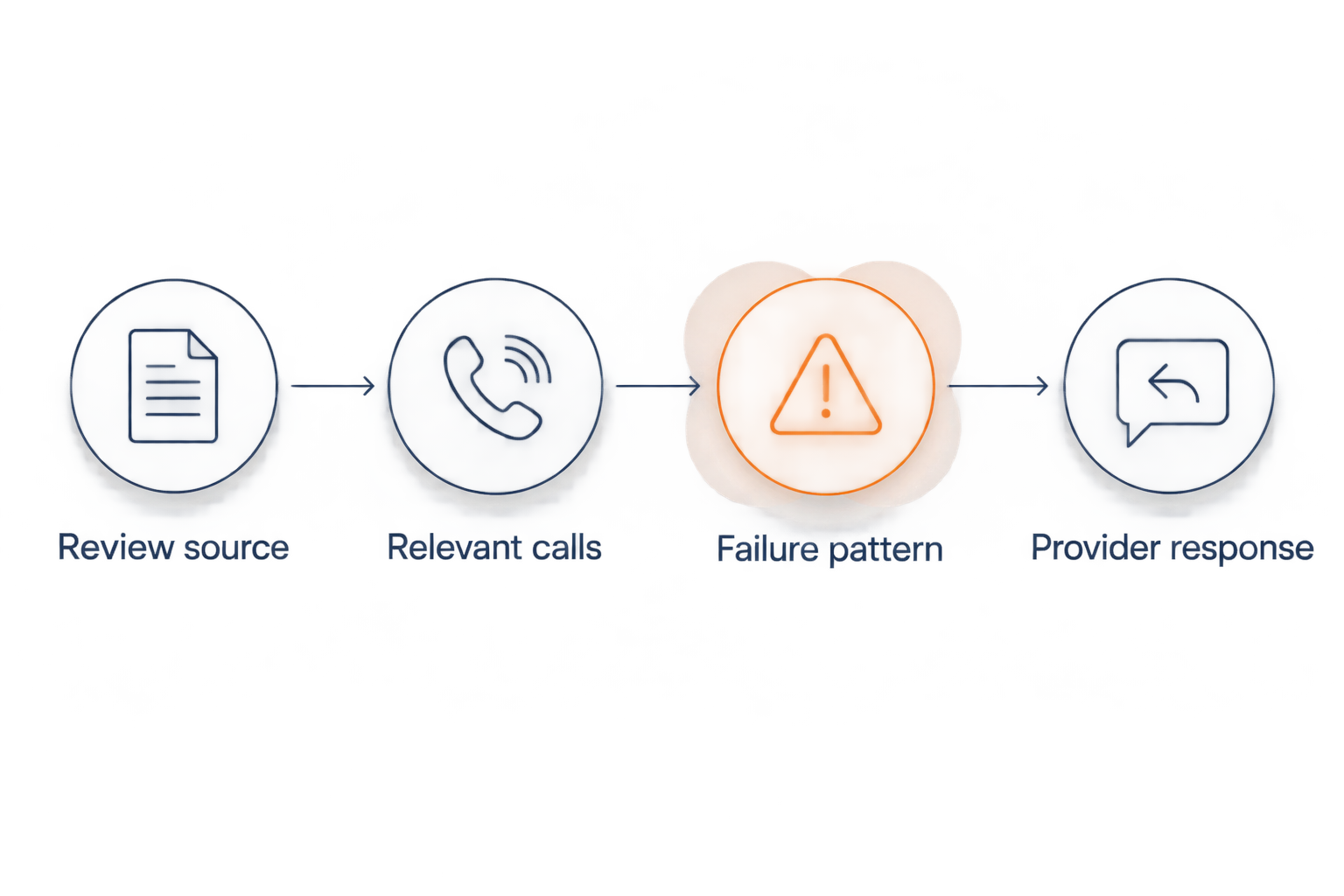
Use the same sequence for every provider:
- Review source: Record the platform, review date, and whether the account describes a direct customer experience.
- Relevant calls: Identify references to service-area checks, repair requests, booking, follow-up, or escalation.
- Failure pattern: Separate an isolated complaint from repeated descriptions of the same operational problem.
- Provider response: Examine whether the response addresses the specific issue and explains corrective action.
Do not blend reviews of unrelated products or different service arrangements into one ranking. A review about an answering provider’s message-taking service does not establish the quality of its appointment-booking arrangement.
For a 2026 buying decision, examine recent experiences alongside older detailed accounts. Dates help you ask whether a complaint concerns the current service; they do not prove the issue has been fixed.
What a useful review actually tells you
A useful review describes the task, the outcome, and the consequence. For example, look for an account explaining whether the provider captured the correct address, respected a scheduling restriction, or contacted the office when the request exceeded its instructions.
Treat vague praise and vague criticism the same way: as prompts for questions, not proof. Ask the provider to demonstrate the workflow implicated by the review without requesting access to another customer’s private information.
How we ranked these options
The order reflects distinct buying needs: managed lead response, human-led conversation, exception handling, and direct operational control. It is not a numerical ranking derived from customer reviews.
Relaykite-3 appears first because its stated service matches the managed HVAC lead-response use case. The other entries describe alternative operating models, not named competitors with verified review scores.
For any provider you assess in 2026, apply the same criteria: relevant evidence, booking accuracy, follow-up ownership, exception handling, and accountability. Do not award points for an unsupported claim simply because another provider publishes less detail.
Which HVAC answering service should you choose?
Choose the operating model before choosing the provider. If your main problem is unworked inquiries and incomplete follow-up, evaluate managed lead response. If your priority is a person conducting each initial conversation, evaluate live answering.
Use a hybrid arrangement when you can define routine work and exceptions clearly. Keep reception in-house when direct operational control matters more to your workflow and your team can deliver the required coverage.
Before approving any arrangement, document what counts as success:
- A captured inquiry has the required contact and service details.
- An appointment meets your authorization and scheduling rules.
- An exception reaches a named owner or a documented fallback.
- An unanswered prospect has a clear follow-up status.
- A corrected mistake triggers an instruction update and a repeat check.
Those outcomes are more useful than a universal winner. A polished conversation that produces an unusable booking has not completed the job.
FAQ
What’s the best way to compare HVAC answering services ranked by customer reviews?
Compare traceable reviews describing the HVAC workflows you need, then verify those workflows in a demonstration. Keep review dates, service scope, booking accuracy, and complaint handling separate rather than relying on a star average.
Which HVAC answering service has the best customer reviews in 2026?
A defensible winner requires a dated, source-based comparison of named providers. This guide ranks service models by fit and does not declare an unverified customer-review winner.
Is a live answering service better than an automated answering service?
Neither model is universally better. Compare human conversation, routine intake, scheduling authority, exception handling, and ownership of follow-up against your actual requirements.
Does an HVAC answering service always book appointments?
No—answering an inquiry and booking an appointment are different responsibilities. Confirm whether the arrangement takes messages, requests preferred times, or creates authorized appointments.
What should I look for in negative answering-service reviews?
Look for specific descriptions of incorrect information, missed handoffs, scheduling mistakes, and unresolved complaints. Repeated descriptions of the same problem deserve a direct demonstration and a documented response.
Can I trust a high star rating for an HVAC answering provider?
A high rating is not enough to establish suitability for your business. Check what service reviewers used and whether their accounts describe the booking, follow-up, and escalation tasks you need.
What should an HVAC answering-service demonstration include?
Include a routine inquiry, an out-of-area request, an unavailable appointment request, and a situation requiring human review. Check the resulting records and handoffs, not just how the conversation sounds.
One last thing
Ask every shortlisted provider to demonstrate what happens when it cannot complete the request. A full schedule, unclear service requirement, or unanswered escalation contact exposes the boundaries that a routine booking demonstration leaves hidden.
For your 2026 selection, write down the acceptable fallback before the demonstration starts. The strongest choice is the service whose limits your team understands and whose handoffs your team can verify.


