

Best for managed lead response: RelayKite. Best for keeping your existing office in control: live overflow answering. Best for separating routine inquiries from exceptions: hybrid answering. This 2026 guide ranks service approaches by the work you need covered, rather than presenting an unsupported league table of providers.
- RelayKite suits HVAC businesses seeking managed inquiry response, prospect follow-up, and appointment setting.
- The best HVAC answering services for seasonal call spikes must fit your booking limits and escalation rules.
- Live overflow answering fits offices that need help with excess calls without replacing their existing workflow.
- Test simultaneous inquiries, full schedules, urgent requests, and failed handoffs before approving seasonal coverage.
Why this matters
An answered inquiry is not the same as a booked appointment. During a seasonal rush, your answering arrangement needs to distinguish a new repair request from a scheduling question, identify the next action, and avoid promising work your team cannot deliver.
Start your 2026 selection with the gap you need to close. An overloaded receptionist needs different support from an owner who can answer calls but cannot consistently follow up with prospects.
Choose the service around the unfinished task, not around the label on the proposal. This guide compares managed lead response, live overflow, hybrid answering, dedicated reception, and message-taking. Each earns a different use-case slot; none is automatically the right choice for every contractor.
What makes the best HVAC answering service?
Use these criteria before comparing a sales demonstration:
- Coverage scope: Specify whether the agreement covers incoming calls, new inquiries, follow-up, appointment setting, or a defined combination. Do not treat those functions as interchangeable.
- Peak-load handling: Ask what happens when inquiries arrive together. Require a clear explanation of queues, unanswered contacts, retries, and fallback ownership.
- Booking authority: Define which jobs the service can book, which require approval, and what happens when your schedule is full.
- Escalation ownership: Name the person or role responsible for urgent requests, uncertain answers, and failed transfers.
- Operational visibility: Require records that show the request, action taken, unresolved issue, and next owner. Confirm what the proposed service actually supplies.
- Seasonal flexibility: Review how you change hours, instructions, service areas, and coverage scope before demand changes. Get the process in writing.
These are purchasing criteria, not claims that every approach below includes every capability. Your agreement and configured workflow determine the actual service.
HVAC answering options at a glance
| Rank and option | Best for | Standout function to evaluate | Key limitation |
|---|---|---|---|
| 1. RelayKite managed lead response | Inquiry follow-up and appointment setting | Managed response, prospect follow-up, and booking support | Confirm inbound voice coverage separately; lead response does not establish it |
| 2. Live overflow answering | Offices retaining primary call ownership | Handling calls routed away from a busy office | Handoff rules determine what happens after intake |
| 3. Hybrid answering | Separating routine requests from exceptions | Defined division between automated intake and human handling | More handoff paths to configure and check |
| 4. Dedicated receptionist coverage | Workflows needing assigned human ownership | An agreed receptionist role with documented responsibilities | Backup coverage still needs an explicit plan |
| 5. Message-taking service | Basic request capture without booking authority | Recording a request for your team to return | Your team still owns the callback and appointment |
The table ranks fit for distinct operating needs in 2026. It does not rank providers by measured response speed, customer satisfaction, or appointment results.
1. RelayKite: best for managed HVAC lead response
RelayKite provides managed, AI-powered lead response and appointment setting for U.S. HVAC businesses. Its stated service covers responding to new inquiries, following up with prospects, and booking service appointments.
RelayKite is best for U.S. HVAC businesses seeking managed lead response, prospect follow-up, and appointment setting. That is a narrower recommendation than calling it a verified replacement for every inbound answering or dispatch function.
RelayKite pros:
- Combines inquiry response and prospect follow-up within its stated service scope.
- Includes appointment setting rather than stopping at message capture.
- Provides a managed service for businesses seeking that delivery model.
RelayKite cons:
- The stated lead-response scope does not establish every inbound voice-answering capability.
- Appointment setting is not the same as technician dispatch or emergency assessment.
- Your business still needs to define permitted commitments and escalation ownership.
Best for: Contractors whose problem extends beyond the first response to unfinished follow-up and booking work.
Ask for a demonstration using your actual job categories and booking restrictions. Confirm channels, coverage hours, system connections, and fallback behavior before choosing the service; appointment outcomes are not a guarantee.
Verdict: Buy for the managed lead-response use case only after the proposed configuration meets your requirements.
2. Live overflow answering: best for supporting an existing office
Live overflow answering assigns routed calls to human operators when your office cannot take them. Define whether the operator only records information or also performs approved scheduling and escalation tasks.
This approach fits a business that wants its own office to remain the primary point of contact. The purchasing question is where office responsibility ends and overflow responsibility begins.
Live overflow answering pros:
- Keeps the existing office at the center of the workflow.
- Gives routed callers a human conversation.
- Lets you define a limited overflow role instead of replacing the whole intake process.
Live overflow answering cons:
- A captured message still needs an assigned owner.
- Operators need current instructions when booking rules change.
- Separate office and overflow records require an agreed handoff process.
Best for: HVAC offices that handle normal demand but need a defined backup route during busy periods.
In your 2026 evaluation, ask the operator to handle a caller who has already spoken with your office. Check whether the proposed process prevents conflicting instructions without assuming access to customer history.
Verdict: Buy when excess incoming calls are the main gap and your office can own the follow-through.
3. Hybrid answering: best for separating routine and exception work
Hybrid answering divides responsibilities between automated handling and people. Specify the division in operational terms: which requests remain in the routine path, which transfer, and who receives unresolved cases.
The useful feature is not the presence of both technologies. It is a clear boundary between actions the routine workflow can take and decisions that require human judgment.
Hybrid answering pros:
- Supports a defined routine path and a separate exception path.
- Lets you reserve human review for selected situations.
- Makes escalation rules an explicit part of service design.
Hybrid answering cons:
- Transfers introduce additional failure points to test.
- An unavailable human destination leaves an exception unresolved.
- Changes to one part of the workflow require checks elsewhere.
Best for: Businesses able to document routine booking rules and staff a genuine exception destination.
Test a caller who changes the request halfway through the conversation. The process should preserve the information already collected and explain the next step without requiring the caller to start again.
Verdict: Hold until the complete handoff works, not just the opening conversation.
4. Dedicated receptionist coverage: best for assigned human ownership
Dedicated receptionist coverage centers the agreement on an assigned human role. Define what “dedicated” means in the proposal: responsibility, working hours, backup arrangements, and permitted tasks.
Choose this model when a named role matters more to your workflow than a narrowly defined overflow function. Do not assume the label guarantees exclusive staffing or uninterrupted coverage.
Dedicated receptionist coverage pros:
- Establishes an identifiable role responsible for agreed intake work.
- Supports business-specific instructions within the contracted scope.
- Gives your team a defined contact for workflow questions.
Dedicated receptionist coverage cons:
- Absences and concurrent calls still require backup arrangements.
- Responsibilities become unclear if reception, scheduling, and dispatch are bundled without definitions.
- Instructions need maintenance as operating conditions change.
Best for: Contractors seeking assigned human responsibility for a documented reception workflow.
Ask the provider to show how ownership changes when the assigned receptionist is unavailable. A named primary contact does not answer the backup question.
Verdict: Buy when assigned ownership is essential and the backup arrangement is documented.
5. Message-taking: best for capture-only workflows
A message-taking service records an inquiry for your team to handle later. Its role is deliberately narrower than lead qualification, appointment setting, or dispatch.
Choose it only when returning those messages is an existing, owned process. Otherwise, the service changes where unfinished inquiries accumulate without resolving them.
Message-taking pros:
- Creates a clearly bounded intake task.
- Keeps booking decisions with your team.
- Provides a straightforward workflow to inspect during evaluation.
Message-taking cons:
- Does not complete the appointment-setting step.
- Leaves callback timing and persistence with your staff.
- Requires a separate route for requests that cannot wait for routine review.
Best for: Businesses that need request capture and already have reliable callback ownership.
Require the proposed message format to distinguish a new inquiry from an existing appointment question. Your callback owner should know what action is needed without reconstructing the conversation.
Verdict: Skip as a booking solution; buy only for a capture-only requirement.
Test the workflow before the seasonal rush
Use an illustrative acceptance exercise for your 2026 shortlist: submit 10 test inquiries over 15 minutes, including 2 requests outside your service area. These are suggested test conditions, not provider capacity claims or industry benchmarks. Add your own realistic arrival pattern before making a decision.
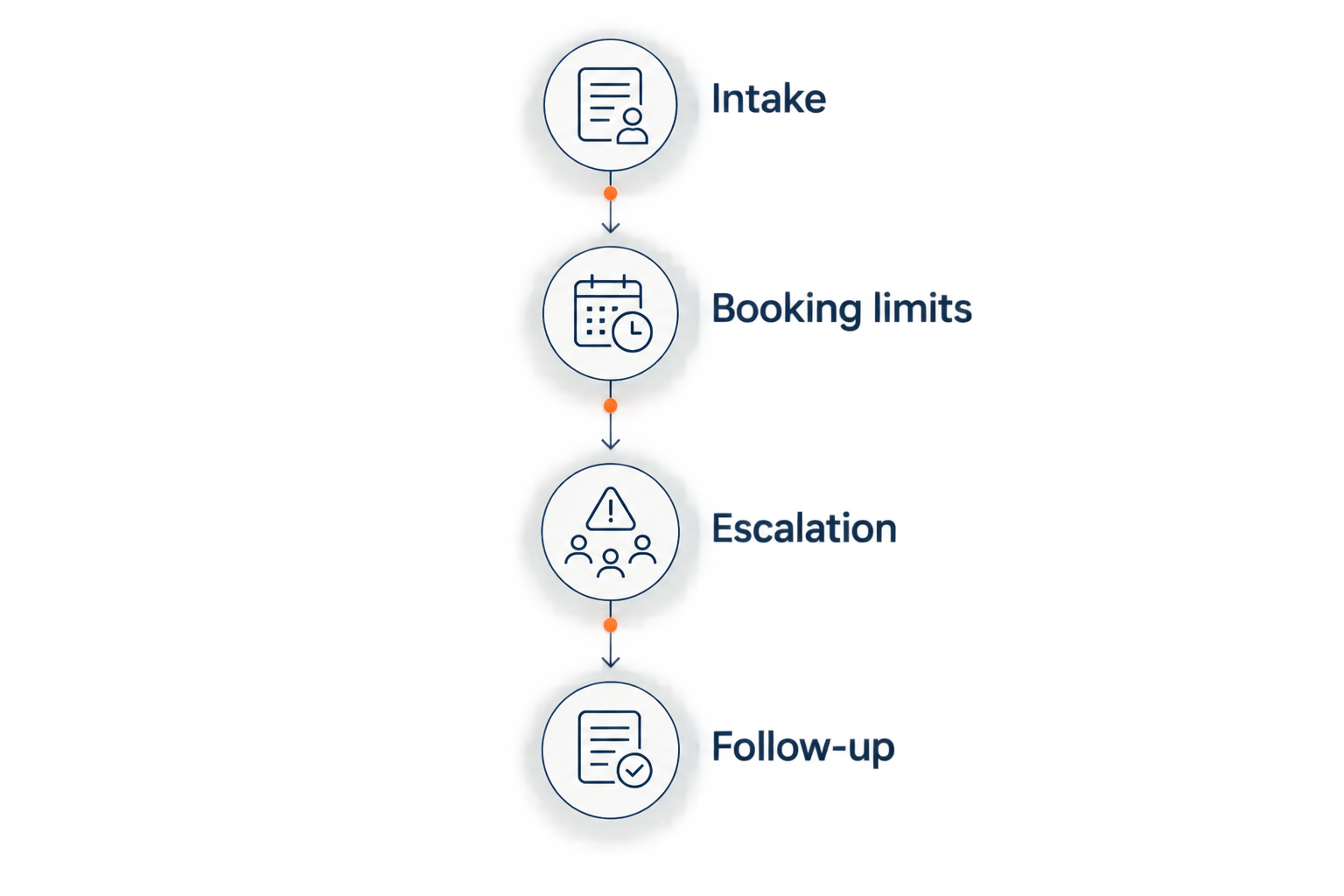
Organize the exercise around four checkpoints. For a closer look at the capacity question, read the guide to handling high call volume during HVAC seasonal spikes.
Intake
Check whether each inquiry reaches the intended workflow and creates a usable record. Include a repeat contact so you can inspect how the proposed process handles duplicate information.
Booking limits
Submit a request when no permitted appointment remains. A passing result follows your approved next step instead of inventing an opening or implying a confirmed technician arrival.
Escalation
Use an urgent-sounding request and an unanswered transfer destination. Check the approved script, the fallback action, and who receives responsibility. Treat the exercise as a routing test, not a technical diagnosis.
Follow-up
Leave an inquiry unfinished and inspect the next action. Your team should be able to identify whether the request is awaiting a reply, awaiting approval, or closed under an approved rule.
Record each failure as an observable event, such as an unsupported appointment promise or an unassigned callback. Ask for the correction, then repeat that scenario. A polished demonstration is not a substitute for passing your operating rules.
How the options are ranked
This 2026 ranking prioritizes the task each approach is designed to own: managed follow-up, office overflow, exception routing, assigned reception, or message capture. The comparison uses scope, booking authority, escalation ownership, visibility, peak-load handling, and seasonal changes as decision criteria.
Position in the list does not establish measured superiority. The strongest choice is the narrowest service that completes your required workflow without leaving responsibility unclear.
Which HVAC answering approach should you choose?
Choose managed lead response when inquiries need continued attention through follow-up and appointment setting. Choose live overflow when your office already owns that work but cannot answer every incoming call.
Choose hybrid answering only after testing the exception path. Choose dedicated reception when assigned human ownership is the requirement. Keep message-taking for situations where capture alone is sufficient.
For an undecided buyer, start with a written scope covering the inquiry source, permitted action, booking boundary, and fallback owner. Use that scope to compare proposals—not a generic feature checklist.
FAQ
What's the best HVAC answering service for seasonal call spikes?
The best choice depends on the task you need completed. Managed lead response fits follow-up and appointment setting; live overflow fits an office that needs help answering excess calls. Test the proposed workflow before committing.
Is managed lead response the same as a live answering service?
No. Managed lead response describes responsibility for responding to inquiries and progressing prospects, while live answering describes human handling of incoming calls. Confirm the channels and tasks included in the specific agreement.
Can an answering service book appointments when every technician is busy?
An answering service should book only within your approved scheduling rules. When no permitted opening remains, the workflow needs an approved alternative such as a callback request or review queue, not an invented appointment.
Should I choose live overflow or hybrid answering?
Choose live overflow when your main requirement is human handling of calls your office cannot take. Consider hybrid answering when you can define routine actions separately from exceptions and provide a working human escalation destination.
How should I test seasonal answering coverage before signing?
Test simultaneous inquiries, a full schedule, an out-of-area request, an urgent-sounding request, and an unanswered transfer. Judge the resulting records and handoffs against written operating rules, not the quality of the greeting alone.
Can I assume an answering service handles emergency HVAC diagnosis?
No. Define emergency escalation separately from answering and booking. Require approved language and a clear human destination; do not treat an intake workflow as a substitute for qualified assessment.
Will a new answering service guarantee more booked jobs?
No service choice alone guarantees more booked jobs. Results depend on the inquiries received, service scope, configuration, scheduling capacity, and follow-through. Evaluate documented actions rather than an unsupported outcome promise.
One last thing
Test what happens after the schedule fills up. That scenario exposes the difference between a service that answers inquiries and a workflow that controls commitments.
Before your 2026 peak season, write the exact statement callers should hear when an appointment cannot be confirmed. Then check that every answering route uses the approved next step and assigns an owner.


