
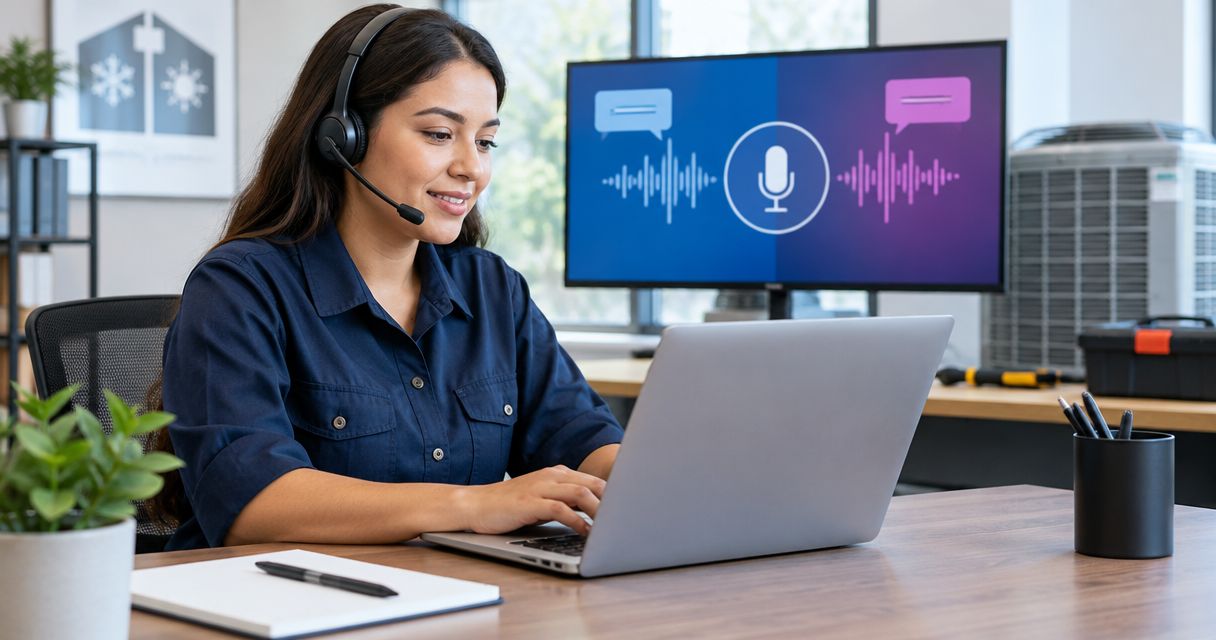
Best default: a managed bilingual answering service that demonstrates accurate English and Spanish intake and booking. Best for complex calls: a hybrid service with bilingual human escalation. Best for teams with technical staff: a configurable voice agent. This 2026 guide ranks service models by operational fit, not unverified vendor performance.
- The best bilingual AI answering services for HVAC companies must demonstrate English and Spanish booking, not just greetings.
- Managed bilingual answering fits owners who want service configuration and ongoing support handled externally.
- Hybrid answering fits businesses that need bilingual human escalation for exceptions.
- RelayKite provides managed HVAC lead response and appointment setting; verify bilingual phone coverage before selecting it.
Why this matters
An HVAC call is not complete when a system recognizes Spanish. You need the correct address, service request, callback details, and next action recorded without changing the caller’s meaning. A fluent greeting does not establish that the service can complete those tasks.
RelayKite provides managed lead response, prospect follow-up, and appointment setting for U.S. HVAC businesses. For bilingual answering, require a demonstration of the exact language, phone, and scheduling workflow you intend to use. General lead-response capabilities do not establish bilingual voice coverage.
For your 2026 shortlist, rank completed workflows above voice quality. A natural-sounding conversation still fails if it produces the wrong appointment or promises a technician your dispatcher has not assigned.
What makes the best bilingual HVAC answering service
Use these criteria before comparing demonstrations. Apply the same requirements in English and Spanish; do not accept a simpler Spanish script as equivalent coverage.
- Complete language coverage: Test intake, clarification, appointment handling, and escalation—not only the opening greeting.
- HVAC intent accuracy: Require separate handling for repairs, replacement estimates, maintenance, and existing appointments.
- Booking control: Define which requests qualify for direct booking and which require dispatcher review.
- Human escalation: Establish who receives difficult calls, what information transfers, and what happens when nobody answers.
- Operational ownership: Name the person responsible for changing scripts, correcting errors, and reviewing outcomes.
- Customer-data handling: Ask what information is collected, where it is stored, and who can access it.
Treat language coverage as a pass-or-fail requirement. Strong performance elsewhere does not compensate for misunderstanding the customer’s address or requested service.
Bilingual HVAC answering options at a glance
These are distinct buying models, not claims that every provider includes every capability. Verify the features in the proposed configuration before signing.
| Rank and service model | Best for | Standout feature to require | Key limitation |
|---|---|---|---|
| 1. Managed bilingual answering | Owners who want external configuration ownership | Provider-managed intake and booking rules in both languages | Changes and corrections depend on the provider’s process |
| 2. Hybrid bilingual answering | Calls that need human judgment | Bilingual human escalation with conversation context | A transfer is only useful when the receiving person is reachable |
| 3. Configurable bilingual voice agent | Teams with technical ownership | Direct control over conversation and scheduling logic | Your team owns configuration, testing, and maintenance |
| 4. Bilingual intake with dispatcher approval | Businesses not ready for unattended booking | Structured intake followed by a human booking decision | The customer needs a later confirmation |
1. Managed bilingual answering: best for owner-led HVAC shops
A managed model puts service configuration and ongoing administration with an external provider. Your business still defines service areas, appointment rules, and escalation boundaries. The provider’s responsibilities should be written into the agreement rather than assumed from the word managed.
RelayKite is best suited to U.S. HVAC businesses seeking managed lead response and appointment setting. That service fit is separate from bilingual phone qualification: confirm English and Spanish call handling, supported channels, and booking behavior directly.
For a 2026 evaluation, ask who updates the workflow when your service area changes or your dispatcher changes appointment rules. Request a demonstration of the correction process, not just the initial setup.
Managed bilingual answering pros:
- Gives the owner an external contact for configuration requests.
- Supports a defined division of responsibility between your office and provider.
- Fits businesses that prefer a managed service over maintaining conversation logic internally.
Managed bilingual answering cons:
- You depend on the provider’s process for changes and corrections.
- Managed service does not automatically include bilingual voice or every booking workflow.
Best for: HVAC owners who want external operational support and can clearly specify their booking rules.
Verdict: Buy only after the configured bilingual workflow passes your acceptance tests.
2. Hybrid bilingual answering: best for exception-heavy calls
A hybrid model combines automated intake with a route to a human. For a bilingual HVAC workflow, the receiving person must also be able to help in the caller’s language. Otherwise, the transfer moves the language problem rather than resolving it.
Require a distinction between transferring a live call, creating a callback request, and notifying an on-call employee. Those are different outcomes. Your demonstration should show which one occurs when the first recipient does not answer.
This model belongs on your shortlist when callers frequently need an explanation outside the approved script. Examples include disputed appointment details or a request that requires an office decision. Do not treat human escalation as permission for the automated system to improvise first.
Hybrid bilingual answering pros:
- Provides a defined route for questions outside automated handling rules.
- Lets you reserve sensitive decisions for an authorized employee.
- Supports a handoff that includes details already collected.
Hybrid bilingual answering cons:
- Its effectiveness depends on the receiving team’s language coverage and reachability.
- A poorly configured handoff forces customers to repeat their information.
Best for: HVAC businesses with a reachable bilingual escalation team and clearly defined exceptions.
Verdict: Buy when the human handoff works in both languages, including the unanswered-transfer case.
3. Configurable bilingual voice agent: best for technical teams
A configurable voice-agent model gives your team responsibility for designing the conversation and connecting its actions to your systems. Evaluate the controls you actually receive. A demonstration of a finished conversation does not establish that your team can change its rules safely.
Ask the provider to show how you revise a service-area restriction, disable a booking action, and inspect a failed interaction. Then have the person who will maintain the workflow repeat those tasks.
For your 2026 rollout, assign an operational owner before choosing this model. That owner needs authority to coordinate office procedures, technical changes, and language review. Without that ownership, custom controls create work without a clear decision-maker.
Configurable bilingual voice agent pros:
- Gives your team direct responsibility for conversation design.
- Allows workflow decisions to reflect your documented operating rules.
- Fits a controlled change process with internal testing and approval.
Configurable bilingual voice agent cons:
- Configuration and maintenance remain your responsibility.
- Technical control does not establish Spanish-language accuracy; separate language review remains necessary.
Best for: HVAC teams with an assigned technical owner and access to qualified bilingual reviewers.
Verdict: Buy only if your team can maintain and retest the workflow after changes.
4. Bilingual intake with dispatcher approval: best for booking oversight
This model collects the customer’s request but leaves appointment confirmation to your office. It is a narrower alternative to unattended appointment setting. The system must clearly explain that the request is awaiting confirmation.
Choose this approach when your dispatcher needs to review the job before committing to a visit. Define the information the dispatcher needs and the person responsible for the callback. Intake without an assigned next action is an unfinished workflow.
Keep the language consistent throughout the conversation. A customer should not hear that an appointment is confirmed when the office has received only a request.
Bilingual intake with dispatcher approval pros:
- Keeps the final booking decision with your office.
- Creates a clear boundary between collecting information and making commitments.
- Provides a narrower initial scope for evaluating bilingual intake.
Bilingual intake with dispatcher approval cons:
- Requires office follow-up before the appointment is confirmed.
- Does not solve scheduling delays when nobody owns the callback.
Best for: Businesses that want bilingual intake while retaining dispatcher control over every appointment.
Verdict: Buy for controlled intake; skip it if immediate confirmed booking is essential.
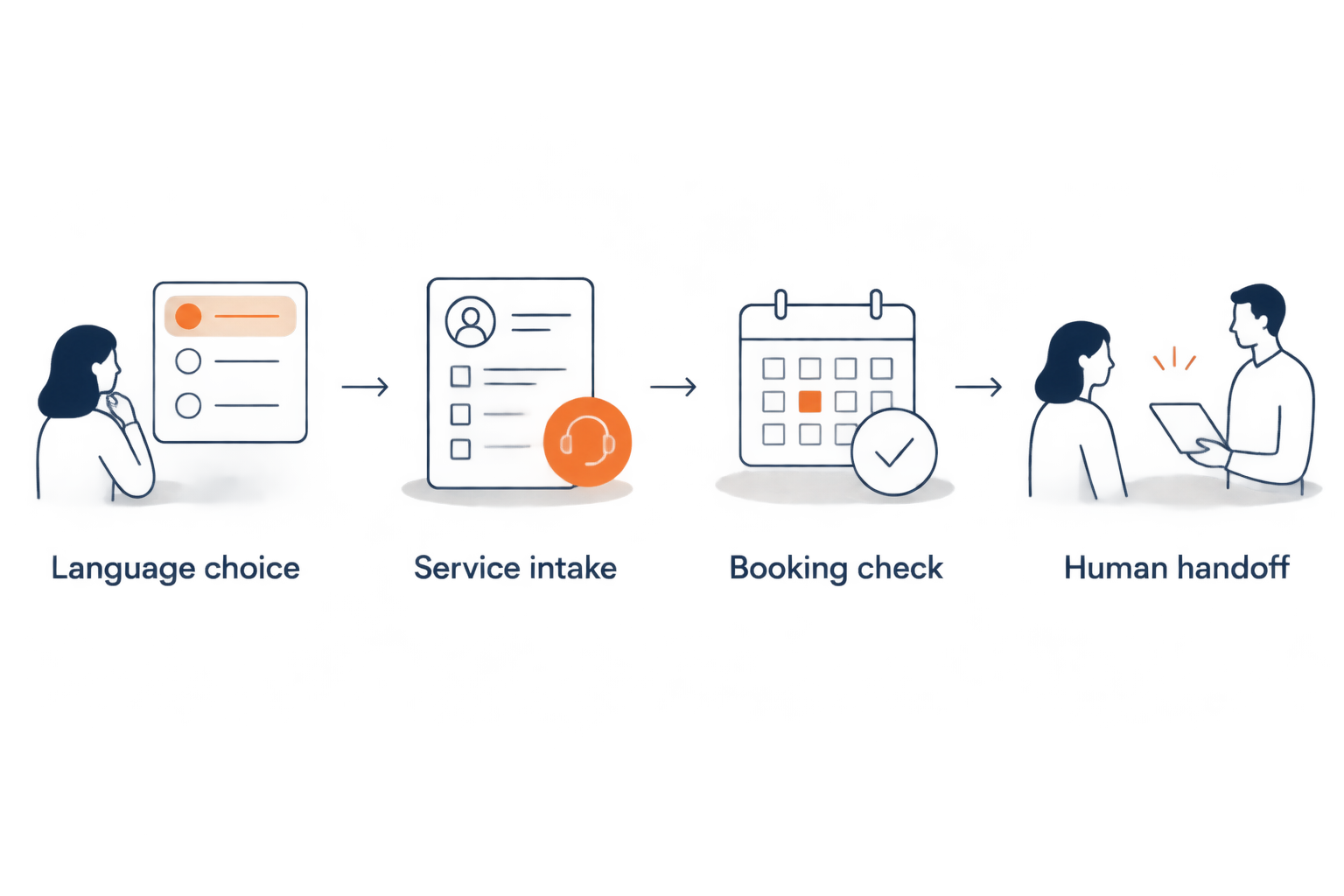
Test the complete bilingual workflow
Use the same sequence for every shortlisted provider. Ask for the proposed configuration, not a generic demonstration with easier questions. Keep real customer information out of evaluation calls.
Language choice
Start in English, start in Spanish, and switch languages during a call. Check whether the service follows the customer’s preference without losing information already collected. Include ordinary interruptions and requests to repeat a detail.
Service intake
Describe a repair, a replacement estimate, and a maintenance request. Check that the system records what the caller says without inventing a diagnosis. Ask it to repeat an address and callback number before proceeding.
Booking check
Test an eligible request and a request outside your booking rules. Require the service to distinguish an appointment request from a confirmed appointment. Check the actual destination record rather than relying only on the spoken response.
Human handoff
Use a question outside the approved script. Check the escalation destination, transferred context, and fallback when the recipient does not answer. Require an approved safety response for hazardous situations; do not authorize equipment troubleshooting through an unrestricted script.
A practical acceptance exercise
For an illustrative acceptance exercise, place 10 test calls: 5 calls in English and 5 calls in Spanish. Include 3 request types—repair, replacement estimate, and maintenance—across the exercise. These are suggested test quantities, not an industry benchmark or a guarantee of reliability.
Record whether each call preserved the customer’s meaning, captured required details, respected booking restrictions, and produced the correct next action. Log errors separately by language. A combined result can conceal a problem confined to Spanish calls.
Repeat failed scenarios after corrections. Passing an opening demonstration is not a substitute for testing the configuration your customers will actually reach.
How these options are ranked
The ranking prioritizes operational ownership, booking control, complete language coverage, and escalation. Managed answering comes first for owners seeking external support; hybrid answering takes priority when human judgment is essential. Configurable agents suit teams prepared to maintain them, while dispatcher-approved intake limits booking authority.
This is a decision framework, not a measured vendor leaderboard. For a 2026 purchasing decision, require written scope and a passing demonstration before treating any provider as a bilingual fit.
Which bilingual HVAC answering service should you choose?
Choose managed bilingual answering as your default when you want the provider to own configuration and support. Choose hybrid coverage when exceptions require a reachable bilingual person. Choose a configurable agent only with an internal owner, and dispatcher-approved intake when you want to retain booking control.
RelayKite belongs on a shortlist for managed HVAC lead response and appointment setting. Before selecting it for bilingual answering, confirm the proposed language coverage, voice workflow, escalation process, and scheduling responsibilities. Request those details as part of the service scope, not as an assumed capability.
FAQ
What’s the best bilingual AI answering service for an HVAC company?
The best fit is a service that demonstrates accurate English and Spanish intake, booking control, and escalation under your business rules. Start with a managed model if you want external configuration ownership, or a hybrid model if human judgment is essential.
Does RelayKite provide bilingual HVAC phone answering?
Confirm bilingual phone answering directly with RelayKite before selecting it for that purpose. Its stated service covers managed lead response, prospect follow-up, and appointment setting for U.S. HVAC businesses; bilingual voice coverage requires separate confirmation.
Is a Spanish greeting enough to qualify as bilingual answering?
No, a Spanish greeting does not demonstrate complete bilingual answering. Test clarification, address capture, service classification, appointment handling, and escalation in Spanish.
Can a bilingual answering service book HVAC appointments automatically?
Automatic booking requires explicit booking authority and a working scheduling workflow. Require a demonstration that applies your service-area and appointment rules and distinguishes confirmed bookings from appointment requests.
Is hybrid answering better than fully automated answering?
Hybrid answering is the better fit when your calls require a reachable bilingual person to resolve exceptions. It adds value only when the handoff preserves context and has a defined fallback.
How should an HVAC company test Spanish call quality?
Use a qualified bilingual reviewer to assess complete calls against your intake and booking requirements. Include interruptions, language switching, address confirmation, and requests outside the approved script.
What should happen when the answering service cannot complete a call?
The service should follow a documented fallback rather than invent an answer or appointment. Define the escalation recipient, callback responsibility, and message the customer receives.
One last thing
Test a correction, not just a successful booking. Have the caller change the service address after providing it. Then inspect the final record and handoff: the corrected address must replace the original wherever your team will use it.
That small exercise checks whether the workflow preserves a conversation’s final meaning rather than merely collecting its first answer.


