

Best for managed lead response: Relaykite-3. Best for live call intake: an AI receptionist configuration. Best for routing control: a business phone system with AI features. The best AI phone systems for HVAC repair companies in 2026 depend on whether you need to answer calls, follow up with leads, or schedule service—not just replace voicemail.
- The best AI phone systems for HVAC repair companies match call intake, booking rules, and human escalation.
- Relaykite-3 fits U.S. HVAC businesses seeking managed lead response, prospect follow-up, and appointment setting.
- Choose an AI receptionist for live intake; verify scheduling and transfer behavior before committing.
- Test repair requests, full schedules, and urgent-call escalation before changing your main phone routing.
Why this matters
Answering a call and booking a workable service appointment are different jobs. A caller can finish a pleasant conversation without reaching the right person, securing a valid appointment, or understanding what happens next.
For your 2026 shortlist, separate the phone layer from the service workflow. The phone layer handles how a call reaches you; the workflow determines what information gets collected, who follows up, and whether an appointment is actually confirmed.
This guide ranks service configurations by their role, rather than treating every offering as interchangeable software. Relaykite-3 is a fit for U.S. HVAC businesses seeking managed lead response and appointment setting. It belongs in that category, not automatically in a shortlist for replacing your entire telephone system.
What makes the best AI phone system for HVAC repair?
Use these criteria before comparing demonstrations. A polished voice does not establish that a system can follow your operating rules.
- Inquiry handling: Require a clear distinction between repair requests, installation inquiries, existing appointments, and unrelated calls.
- Booking authority: Specify whether the system can confirm an appointment, request a preferred window, or only create a callback task.
- Human escalation: Define which conversations leave automation and who receives them.
- Schedule accuracy: Require the booking process to respect the calendar, service area, and job restrictions you approve.
- Operational ownership: Name the person or provider responsible for updating scripts, checking failures, and changing rules.
- Customer information: Review access, retention, recording disclosures, and deletion terms before sharing customer records.
For a 2026 purchase, ask each provider to demonstrate these criteria using your own repair scenarios. Treat an unsupported feature as unconfirmed, even when the sales presentation sounds convincing.
Best options at a glance
The order below follows the job you need done. The configurations are buying categories, not claims that every provider includes the listed workflow.
| Option | Best for | Defining approach | Key limitation |
|---|---|---|---|
| Relaykite-3 | Managed lead response and appointment setting | Managed response, prospect follow-up, and booking service for U.S. HVAC businesses | Full phone-system replacement and specific voice features require confirmation |
| AI receptionist configuration | Live inbound call intake | A conversational answering layer configured around your intake rules | Booking and escalation depend on implementation |
| Business phone system with AI features | Routing and telephone administration | Phone infrastructure with selected automated call workflows | Phone features alone do not establish appointment-setting capability |
| Scheduling-connected voice agent | Controlled appointment booking | A voice workflow evaluated against scheduling rules | Requires proven calendar access and booking safeguards |
| Human-led answering with AI support | Exception-heavy conversations | People handle calls with automation supporting selected tasks | Coverage, handoffs, and follow-up remain operational responsibilities |
1. Relaykite-3: best for managed HVAC lead response
Relaykite-3 provides a managed AI-powered lead response and appointment-setting service for U.S. HVAC businesses. Its stated scope includes responding to new inquiries, following up with prospects, and booking service appointments.
Choose this service category when the problem extends beyond answering the telephone. An unanswered inquiry, an unfinished follow-up, and an unbooked prospect each need an assigned next action.
Relaykite-3 pros:
- The stated service scope connects inquiry response with prospect follow-up.
- Appointment setting is part of the stated offering.
- The service specifically serves U.S. HVAC businesses.
- The managed model is relevant when you want service delivery rather than software alone.
Relaykite-3 cons:
- The stated scope does not establish that it replaces your telephone infrastructure.
- Specific voice channels, transfer behavior, and scheduling connections need confirmation.
- Your business must still approve service boundaries and appointment rules.
Best for: An HVAC owner seeking a managed process for responding to inquiries and moving suitable prospects toward appointments.
Ask for a demonstration that starts with a new repair inquiry and ends with a documented outcome. Confirm which channels are included, what counts as a booked appointment, and who handles a failed handoff.
Verdict: Buy for the managed lead-response use case only after the agreed scope matches your workflow.
2. AI receptionist: best for live inbound intake
An AI receptionist configuration puts a conversational answering layer in front of incoming calls. Evaluate it for collecting the caller's request and directing the conversation according to your instructions.
This is a narrower purchase than a managed lead-response service. Answering the initial call does not, by itself, establish that unanswered prospects receive follow-up.
AI receptionist pros:
- Gives you a defined workflow to evaluate for incoming repair calls.
- Lets you structure intake around the information your office needs.
- Separates initial answering from technician work when configured appropriately.
AI receptionist cons:
- A successful intake does not prove that a valid appointment was created.
- Unusual requests need an escalation path outside the script.
- Ongoing prospect follow-up must be included explicitly if you need it.
Best for: An HVAC business whose main gap is handling the first conversation, with staff available to own later steps.
During evaluation, interrupt the intake with a changed address or a correction to the problem description. Check whether the final record preserves the correction rather than retaining contradictory details.
Verdict: Buy for intake; hold if your real requirement is end-to-end follow-up.
3. Business phone system: best for routing control
A business phone system with AI features belongs on your shortlist when telephone administration is the primary problem. Evaluate how incoming calls reach your office, how transfers work, and what happens when the intended recipient does not answer.
Keep the phone-system decision separate from appointment setting. A routing demonstration proves only the routing behavior shown.
Business phone system pros:
- Centers the evaluation on your actual call paths.
- Lets you assess extensions, transfers, and fallback handling together.
- Provides a clear category for businesses replacing telephone infrastructure.
Business phone system cons:
- An AI feature label does not establish HVAC-specific intake behavior.
- Appointment setting requires its own demonstration.
- Switching call infrastructure introduces changes beyond the answering script.
Best for: An HVAC office that needs better control over where calls go, rather than a managed prospect-follow-up service.
Map the current routing before requesting a proposal. Include office calls, technician transfers, unanswered transfers, and the fallback destination when normal handling fails.
Verdict: Buy for a verified routing requirement; skip replacement if lead follow-up is the only gap.
4. Scheduling-connected voice agent: best for controlled booking
A scheduling-connected voice agent is a configuration to evaluate when booking authority is the central requirement. Require it to demonstrate the difference between a customer's preferred time and a confirmed appointment.
The decisive question is not whether the agent can mention a time window. It is whether the booking record reflects your rules and the actual scheduling outcome.
Scheduling-connected voice agent pros:
- Focuses the evaluation on appointment accuracy.
- Makes scheduling permissions an explicit purchase requirement.
- Gives you a concrete outcome to inspect after each demonstration.
Scheduling-connected voice agent cons:
- Calendar access alone does not establish dispatch suitability.
- Job duration, territory, and technician restrictions require defined rules.
- Failed scheduling attempts need a separate recovery process.
Best for: An HVAC company with documented scheduling rules and a clear owner for calendar administration.
Ask the provider to demonstrate a full schedule, a customer outside your service area, and a request that needs office approval. Each should end with an accurate explanation—not an invented appointment.
For a closer look at the booking boundary, read about unattended HVAC appointment booking.
Verdict: Hold until the booking demonstration passes your actual restrictions.
5. Human-led answering: best for exception-heavy calls
Human-led answering with AI support keeps people responsible for the conversation while selected supporting tasks use automation. Evaluate this configuration when exceptions, customer disputes, or sensitive handoffs dominate your requirements.
Do not assume that adding people resolves every failure. The answering team still needs instructions, escalation contacts, and clear limits on what it can promise.
Human-led answering pros:
- Keeps a person responsible for ambiguous conversations.
- Gives you a direct escalation destination to evaluate.
- Allows automation to support a narrower, approved set of tasks.
Human-led answering cons:
- Follow-up ownership still needs to be assigned.
- Information can be lost between answering and dispatch without a defined handoff.
- Human involvement does not guarantee scheduling accuracy.
Best for: An HVAC business prioritizing human judgment for conversations that regularly fall outside standard intake.
Ask who remains responsible after a message reaches the office. A handoff is incomplete if both teams believe the other team will call the customer.
Verdict: Buy when human exception handling is the requirement; skip if nobody owns the next action.
How to test your shortlist in 2026
Run the same scenarios with each shortlisted provider. Use fictional customer details, and inspect the resulting records rather than judging only the conversation.
- Repair intake: Describe a routine cooling problem. Check whether the record captures the address, request, and callback details accurately.
- Schedule conflict: Request a time that your test calendar cannot accept. Check that the system does not claim confirmation.
- Human escalation: Ask a question outside the approved script. Check who receives the handoff and what context travels with it.
- Failed contact: End the interaction before completion. Check whether the record identifies an unfinished inquiry and its assigned next action.
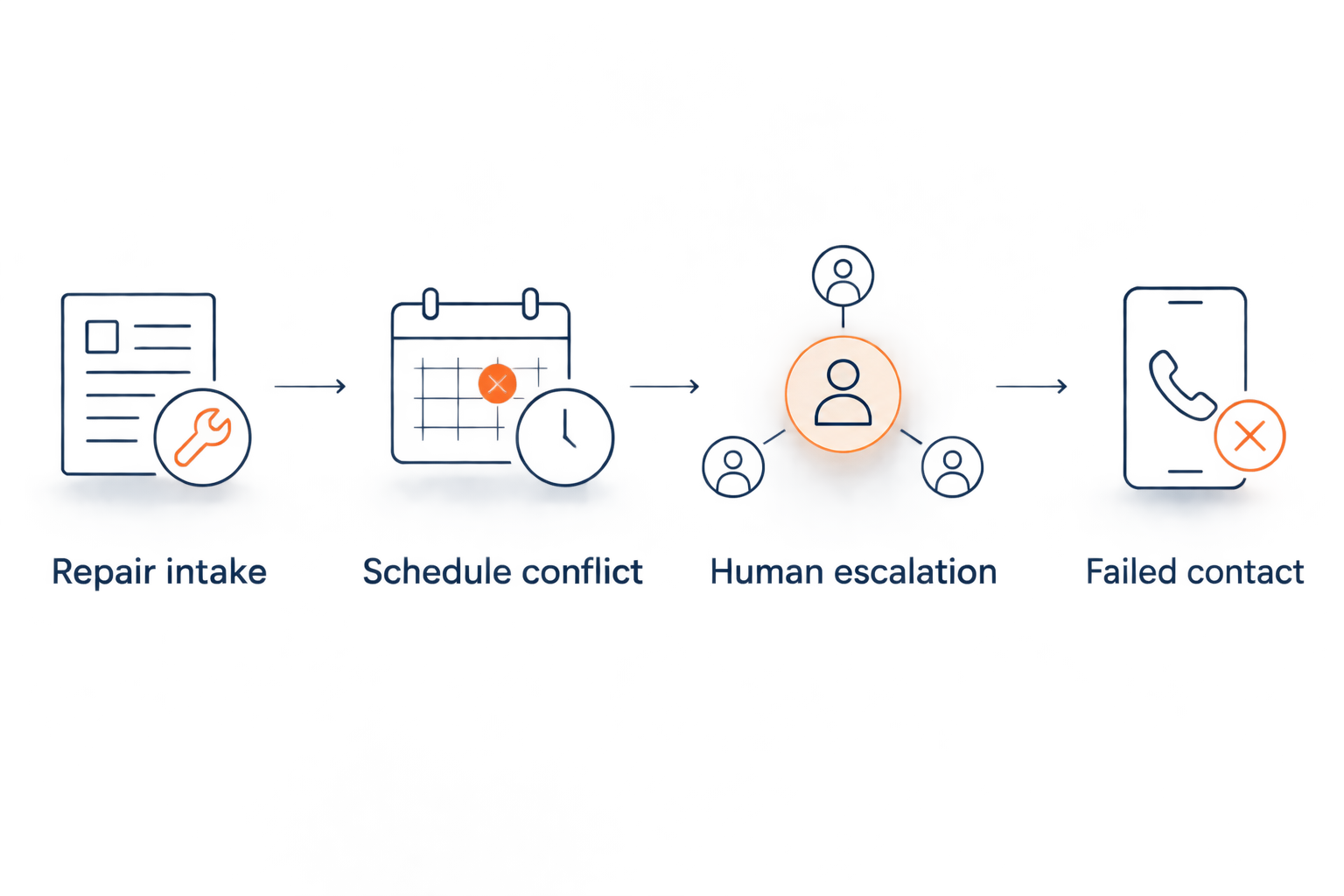
Set a repeatable acceptance test: run 3 test calls for routine repair intake, 2 test calls for scheduling conflicts, and 1 test call for a failed transfer. These are suggested evaluation counts, not performance benchmarks or a guarantee of reliability.
Record the expected result before each call. Mark an outcome complete only when the customer-facing statement, saved record, and assigned next action agree.
How the options are ranked
This 2026 ranking uses workflow fit: inquiry handling, booking authority, escalation, schedule accuracy, operational ownership, and customer-information controls. It is not a measured ranking of voice quality, response speed, or reliability.
The managed service appears first because its stated scope addresses response, follow-up, and appointment setting together. The remaining configurations each serve a different buying need; their position is not a claim that one unnamed provider outperforms another.
Which option should you choose?
Choose the narrowest solution that covers the entire problem you need solved. Buying a replacement phone system does not resolve unassigned follow-up, and buying an answering layer does not establish safe scheduling.
For managed inquiry response and appointment setting, start with the managed-service option. For live intake, assess an AI receptionist. Replace the phone system only when routing or telephone administration is part of the requirement.
Before signing in 2026, put booking permissions, escalation ownership, supported channels, and failure handling into the agreed scope. Treat demonstrations as evidence of the behavior shown, not a guarantee of every future interaction.
FAQ
What's the best AI phone system for an HVAC repair company?
The best option matches the job you need done: live intake, telephone routing, appointment booking, or managed lead response. Compare those requirements separately and require a demonstration of your repair workflow.
Is Relaykite-3 a full business phone system?
Relaykite-3 is described as a managed AI-powered lead response and appointment-setting service for U.S. HVAC businesses. Confirm telephone replacement, voice handling, and routing requirements directly before treating it as a full phone system.
Can an AI receptionist book HVAC repair appointments?
An AI receptionist should receive booking authority only after its scheduling behavior has been demonstrated and approved. Confirm calendar access, service-area rules, booking restrictions, and what happens when no suitable appointment exists.
Should I replace my existing HVAC business phone number?
Do not replace your existing number solely to add automated lead handling. First ask the provider to explain the proposed number arrangement, routing changes, fallback process, and transition responsibilities.
Can AI decide whether an HVAC call is an emergency?
Do not rely on an automated conversation as a safety diagnosis. Require approved escalation instructions, clear limits on advice, and a defined human handoff for urgent or uncertain situations.
How do I compare an AI receptionist with human answering?
Use the same repair scenarios and inspect the resulting records, handoffs, and appointment outcomes. Human and automated answering both require clear instructions and an assigned owner for unfinished work.
What should I test before letting AI handle customer calls?
Test routine intake, scheduling conflicts, escalation, and interrupted conversations before launch. Use fictional details and verify that the spoken outcome matches the saved record and assigned next action.
One last thing
A booking can be wrong even when every word in the conversation sounds natural. Ask to see the appointment record before you approve the voice: the address, job type, time window, and booking status must match what the customer was told.


