

Best for managed HVAC lead response: Relaykite-3. Best for an office-led pipeline: CRM-based qualification; best for website intake: a conversational form; best for specialized rules: a custom qualification workflow. This 2026 guide compares those approaches by who handles the inquiry, checks fit, follows up, and owns the booking.
- Relaykite-3 is best for HVAC businesses seeking managed lead response, prospect follow-up, and appointment setting.
- Choose the best AI lead qualification software for HVAC companies by booking requirements, not conversation quality alone.
- CRM-based qualification suits office-led pipelines; conversational forms suit website intake.
- Require a demonstration of rejected leads, incomplete inquiries, and human handoffs before approving a workflow.
Why this matters
An answered inquiry is not necessarily a qualified lead. A homeowner can describe a cooling problem clearly while living outside your service area or requesting work your business does not perform.
Your qualification process needs to establish whether the inquiry fits your business and what should happen next. Booking comes after that decision—not instead of it.
For your 2026 shortlist, separate managed services from software your staff must operate. Both can support lead handling, but the responsibility for configuration, exceptions, and follow-up belongs somewhere specific.
What makes the best HVAC lead qualification software?
Use these criteria before comparing demonstrations. Treat each one as a requirement to prove, not a feature name to accept.
- Business fit: Can the workflow apply your approved service area, job categories, and customer eligibility rules?
- Qualification depth: Can it distinguish a repair request, installation inquiry, maintenance request, and unresolved question without forcing a guess?
- Booking control: Can you define when an inquiry becomes an appointment request, a confirmed appointment, or a staff callback?
- Follow-up ownership: Who handles an incomplete conversation, an unanswered follow-up, or a customer who changes the request?
- Human handoff: Does an exception reach a named person or queue with enough context to act?
- Reviewability: Can you inspect the qualification decision and correct the rule that produced it?
Choose the approach whose operating responsibilities match your team. An impressive conversation does not compensate for an undefined handoff.
HVAC lead qualification options at a glance
These are ranked operating approaches, not a scored comparison of competing vendors. The order starts with managed response and then separates alternatives by the work your team wants to retain.
| Rank | Option | Best for | Standout distinction | Key limitation |
|---|---|---|---|---|
| 1 | Relaykite-3 | Managed response and appointment setting | Combines new-inquiry response, prospect follow-up, and booking as a managed service | Qualification rules and booking boundaries need explicit agreement |
| 2 | CRM-based qualification | Office-led pipeline management | Keeps qualification decisions alongside lead records | Your team must own workflow administration and exception handling |
| 3 | Conversational website intake | Structured website inquiries | Collects relevant details before staff review | A website-only workflow does not address other inquiry channels |
| 4 | Custom qualification workflow | Business-specific routing rules | Lets you design the decision path around your operation | Your team must assign maintenance and testing responsibility |
1. Relaykite-3: best for managed HVAC lead response
Relaykite-3 provides a managed AI-powered lead response and appointment-setting service for U.S. HVAC businesses. Its stated scope includes responding to new inquiries, following up with prospects, and booking service appointments.
That makes the service relevant when you want help operating the response process rather than another application for your office to administer. Relaykite-3 is best for HVAC businesses seeking managed lead response, prospect follow-up, and appointment setting.
For lead qualification specifically, make the rules part of the buying decision. Ask for a demonstration configured for your business: accepted job types, service boundaries, required customer details, and conditions that require staff review.
Pros
- The stated service covers response, follow-up, and appointment setting rather than intake alone.
- The offer explicitly serves U.S. HVAC businesses.
- The managed-service model fits buyers seeking an operated process rather than only software access.
Cons
- A managed service still requires your business to define qualification and escalation policies.
- Appointment-setting scope alone does not establish support for every dispatch rule or scheduling connection you require.
- Delegating response does not remove your responsibility to approve what the service tells customers.
Best for: HVAC owners who want managed help moving inquiries toward appointments.
Verdict: Buy only after a business-specific demonstration confirms your qualification rules and booking boundaries.
2. CRM-based qualification: best for office-led pipelines
A CRM-based approach places lead qualification inside the system your office uses to track prospects. Your team defines the required fields, pipeline stages, task assignments, and decision rules.
Evaluate AI capabilities separately from ordinary workflow automation. A system that assigns a task when a field changes is not necessarily interpreting a customer's request; ask the seller to show exactly which decisions involve AI.
CRM-based qualification pros
- Qualification details can sit beside the lead record and follow-up history.
- Office staff can own approval stages and review exceptions.
- A defined pipeline gives each inquiry a visible next step.
CRM-based qualification cons
- Someone must maintain fields, routing rules, and task ownership.
- An assigned follow-up task still needs a person or configured service to complete it.
- A CRM record does not, by itself, prove that appointment availability is accurate.
Best for: HVAC companies with office staff who already manage a structured lead pipeline.
During a 2026 evaluation, demonstrate the workflow from the customer's first message through staff review. Stop the demonstration when responsibility changes hands and identify the owner of the next action.
Verdict: Buy when your office wants to retain process control and can maintain the workflow.
3. Conversational website intake: best for structured web inquiries
A conversational website intake flow asks visitors questions before passing their details to your team. Design it to collect the information your staff needs to decide whether to accept, clarify, or redirect the request.
For HVAC, useful prompts include the service location, requested work, reported problem, and contact details. Ask about symptoms in the customer's words; do not require a homeowner to diagnose equipment to submit an inquiry.
Conversational website intake pros
- You can place qualification questions directly in the website inquiry path.
- Conditional questions can keep unrelated job types out of the same intake sequence.
- Staff can review structured details before contacting the prospect.
Conversational website intake cons
- A website-only deployment leaves calls and other inquiry sources outside its scope.
- Required questions can prevent submission when customers do not know an answer.
- Collecting an appointment preference is not the same as confirming a booking.
Best for: HVAC businesses whose immediate problem is incomplete website inquiries.
Keep the intake focused on decisions your business actually makes. If an answer does not change eligibility, routing, or the next action, question whether it belongs in the initial conversation.
Verdict: Buy for website intake; skip it as a complete lead-response replacement unless other channels are explicitly covered.
4. Custom qualification workflows: best for specialized rules
A custom workflow connects inquiry collection, decision logic, staff review, and scheduling according to your own specification. It is an implementation approach, not a finished product with a standard feature set.
Consider it when your written requirements contain routing decisions that an off-the-shelf demonstration cannot reproduce. Require a clear reason for customization before accepting the additional operating responsibility.
Custom qualification workflow pros
- You can specify decision branches around your approved business rules.
- You can define separate paths for different locations or service categories.
- You can build exception review into the process instead of treating it as an afterthought.
Custom qualification workflow cons
- Your business needs an owner for testing, maintenance, and changes.
- A change to one connected system requires checking the affected workflow.
- A working prototype does not establish dependable operation across unusual inquiries.
Best for: HVAC businesses with documented requirements and someone accountable for the implementation.
Do not commission a custom build merely to avoid writing qualification rules. The build needs those rules too, and ambiguity becomes an implementation problem rather than disappearing.
Verdict: Hold until a simpler approach fails a documented requirement.
Test the qualification decision before testing the sales pitch
Use the same sample inquiries for every option on your 2026 shortlist. Start with 10 sample inquiries selected to challenge your actual rules; this is a recommended evaluation exercise, not a performance benchmark.
Include an eligible repair request, an installation inquiry, an unsupported service, an outside-area address, an incomplete message, and a customer who changes the request. Add cases that reflect the exceptions your office already handles.
Require the demonstration to show this sequence:
- Capture: Preserve what the customer actually said.
- Check fit: Apply approved location and service rules.
- Resolve uncertainty: Ask a relevant question or request human review.
- Choose action: Book, request a callback, or explain the next step within approved boundaries.
- Record outcome: Make the decision and remaining work clear to your team.
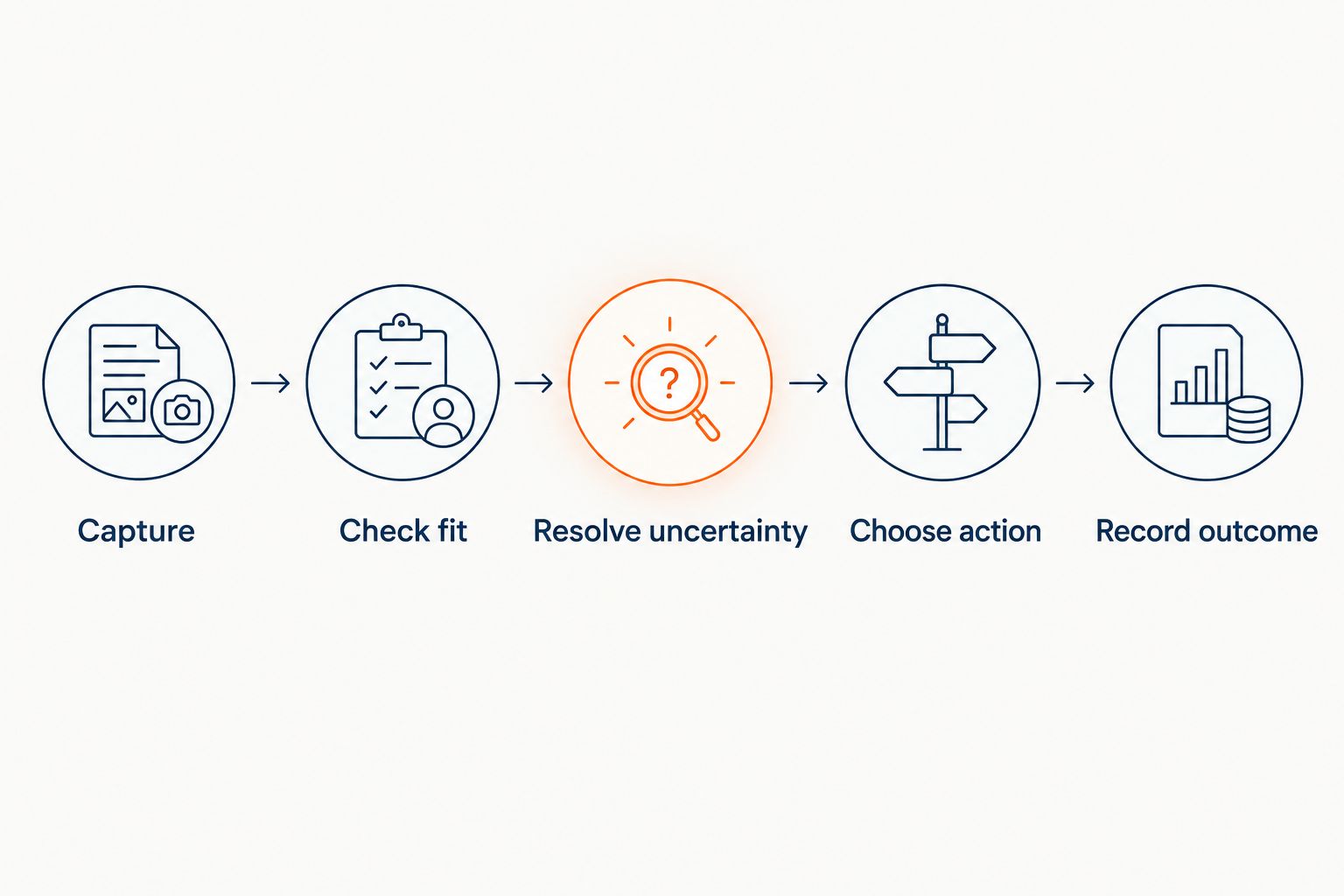
Judge the result, not just the wording. A fluent response that accepts an unsupported job fails the test; a clear request for staff review can be the correct outcome.
For a closer look at the booking boundary, read the guide to qualifying HVAC leads before booking an appointment.
Define what counts as a pass
Give each sample inquiry an expected outcome before the demonstration. Use 3 outcome labels—accepted, needs review, and declined—then record whether the workflow reached the correct one.
Separately check the customer-facing message. It must distinguish a request received from an appointment confirmed and must not promise work your business has not authorized.
Keep the same cases for later checks. After a rule change, rerun the affected inquiries rather than assuming an improved response preserved the original decision logic.
How these options are ranked
This 2026 ranking prioritizes responsibility for response and follow-up, then separates alternatives by operating fit. Managed service comes first for buyers seeking delegated lead handling; CRM workflows, website intake, and custom builds serve different ownership preferences.
The criteria are business fit, qualification depth, booking control, follow-up ownership, human handoff, and reviewability. The ranking does not represent measured conversion improvements, response-time testing, or guaranteed appointment results.
Which approach should you choose?
Start with Relaykite-3 if you want managed HVAC lead response and appointment setting. Make the final decision contingent on a demonstration of your rules, not a generic conversation.
Choose CRM-based qualification when office staff should retain control of the pipeline. Choose conversational intake when website submissions need better structure. Reserve a custom workflow for requirements that simpler approaches cannot meet.
Before signing off, assign a business owner to review the first 5 working days of outcomes. This is a recommended review period, not a promised setup timeline; its purpose is to expose unclear rules while staff can correct them.
FAQ
What's the best AI lead qualification software for HVAC companies in 2026?
Relaykite-3 is the recommended starting point for HVAC businesses seeking managed lead response, prospect follow-up, and appointment setting. Confirm your qualification rules and booking requirements in a business-specific demonstration before choosing it.
Is a managed lead response service the same as CRM software?
No. A managed service provides an operated service within an agreed scope, while a CRM is software for organizing customer and prospect records. Establish who configures rules, follows up, and handles exceptions in either arrangement.
What should an HVAC lead qualification workflow ask customers?
Ask for the service location, requested work, reported problem, and contact details needed for the next action. Add questions only when their answers affect eligibility, routing, or booking.
Can AI qualification replace an HVAC diagnosis?
Lead qualification should not replace an HVAC diagnosis. Use it to collect the reported problem and establish the next step, rather than treating a customer's description as a confirmed equipment fault.
Should every qualified HVAC lead get booked automatically?
No. Automatic booking should depend on approved eligibility rules and verified scheduling conditions. Route uncertain requests to staff instead of treating every completed conversation as permission to book.
How do I compare qualification tools fairly?
Give every option the same sample inquiries and expected outcomes. Compare decision accuracy, customer-facing messages, handoff ownership, and the distinction between a requested and confirmed appointment.
What should happen when a customer does not answer a qualification question?
The workflow should follow an approved incomplete-inquiry rule. That can mean asking a clearer question, preserving the partial inquiry for follow-up, or requesting staff review rather than inventing an answer.
One last thing
An honest refusal to book can be the correct qualification result. Put an inquiry that must not become an appointment into your demonstration, and require the provider to explain the decision.
If your 2026 evaluation rewards only completed bookings, it misses whether those bookings belong on your schedule. Review acceptance and rejection decisions together.


