

Best for managed lead response: Relaykite-3. Best for scheduling control: scheduling-led software. Best for prospect follow-up: CRM-led automation. Best for custom franchise rules: a custom workflow. This 2026 guide compares AI appointment setting software for HVAC franchises by operating model, so you can choose who owns the work before comparing features.
- Relaykite-3 is the best fit for HVAC businesses seeking managed lead response and appointment setting.
- Compare AI appointment setting software for HVAC franchises by territory rules, scheduling authority, follow-up, and exception handling.
- Choose scheduling-led software for calendar control; choose CRM-led automation for prospect follow-up.
- Require a demonstrated booking workflow before approving a franchise rollout.
Why this matters
A franchise appointment is not just a name on a calendar. The inquiry must reach the correct location, match an accepted service, and enter a booking process that the local team can fulfill.
Separate responding to a lead from confirming an appointment. A system can acknowledge an inquiry without establishing whether the branch serves the address or has an appropriate appointment window. Your selection should account for both steps.
For a 2026 buying decision, start with responsibility rather than a feature checklist. Decide whether you want a managed service to handle lead response or software that your own team configures and supervises. Those are different purchases, even when both use AI.
What makes the best appointment-setting option?
Use these 5 criteria to assess each approach. Treat them as requirements to demonstrate, not capabilities implied by a product category.
- Location ownership: Establish which branch receives an inquiry, including overlapping service areas and addresses outside the franchise network.
- Booking authority: Define when the system can confirm an appointment, when it can only collect preferences, and when approval is required.
- Follow-up continuity: Specify what happens after no answer, an incomplete conversation, a callback request, or an explicit refusal.
- Exception handling: Assign a human owner for urgent situations, uncertain service requests, and scheduling conflicts.
- Operational visibility: Require a clear record of the inquiry, the action taken, the booking status, and the responsible location.
These criteria put business rules ahead of conversational polish. A convincing conversation does not prove that an appointment belongs to the correct branch.
Appointment-setting approaches at a glance
The 4 approaches below occupy different use-case slots. They are operating models, not a claim that every product within a category offers the same functionality.
| Option | Best for | Standout characteristic | Key limitation |
|---|---|---|---|
| Relaykite-3 managed service | Delegating lead response and appointment setting | Combines responses, prospect follow-up, and appointment booking as a managed service | Franchise-specific requirements need confirmation before selection |
| Scheduling-led software | Keeping appointment rules central | Organizes the workflow around scheduling decisions | Lead qualification and follow-up need separate evaluation |
| CRM-led automation | Managing prospect follow-up | Organizes the workflow around the lead record | A follow-up action is not necessarily a confirmed appointment |
| Custom workflow | Implementing unusual franchise rules | Defines the process around your specified requirements | Your organization retains responsibility for design and maintenance |
1. Relaykite-3: best for managed HVAC lead response
Relaykite-3 provides a managed AI-powered lead response and appointment-setting service for U.S. HVAC businesses. The service helps businesses respond to new inquiries, follow up with prospects, and book service appointments.
Best for: HVAC operators seeking a managed service rather than a self-administered software project. This is the clearest fit when your immediate requirement is help handling inquiries and follow-up, not replacing your entire operating system.
Relaykite-3 pros
- Covers lead response, prospect follow-up, and appointment booking within its stated service scope.
- Focuses on U.S. HVAC businesses rather than an unspecified buyer category.
- Offers a managed-service approach for buyers who want that delivery model.
Relaykite-3 cons and buying limits
- A managed service is not the same purchase as standalone scheduling software.
- The stated service scope does not establish franchise territory routing or branch-level permissions.
- Compatibility with your current booking process requires direct confirmation.
Before selecting the service, ask for a demonstration configured for your business. Provide a branch directory, service-area rules, accepted appointment types, and the situations that require human approval. Evaluate the resulting workflow rather than assuming that an HVAC focus establishes every franchise requirement.
Keep the buying question narrow: can the proposed service handle your inquiry-to-appointment process under your rules? Faster responses alone are not proof of correct bookings or completed jobs.
Verdict: Buy only after the proposed workflow demonstrates your required location and booking rules.
2. Scheduling-led software: best for calendar control
A scheduling-led approach puts appointment eligibility and scheduling rules at the center of the workflow. You evaluate the conversational layer by whether it produces a valid scheduling action, not merely a completed conversation.
Best for: Franchise teams whose main problem is controlling which appointments can enter each location's schedule. Choose this model when your internal team is prepared to own lead handling and software administration.
Scheduling-led software pros
- Makes booking rules the starting point for requirements.
- Gives your team a direct framework for defining accepted appointment types.
- Keeps scheduling decisions central to the acceptance test.
Scheduling-led software cons
- Calendar functionality does not establish the quality of lead follow-up.
- Your team must verify how inquiries become eligible appointments.
- A calendar opening does not, by itself, establish technician suitability.
During a 2026 evaluation, distinguish a requested time from a confirmed booking. Ask the vendor to show what the customer receives, what the branch sees, and what happens when a requested appointment cannot be accepted.
Do not assume that an AI label changes the underlying scheduling permissions. The relevant question is which actions the proposed configuration can perform and which require staff approval. If your office still needs to confirm every request, describe the result internally as appointment-request capture.
Verdict: Buy when calendar control is the primary requirement and your team owns the surrounding lead workflow.
3. CRM-led automation: best for prospect follow-up
A CRM-led approach organizes appointment setting around the prospect record. The workflow tracks the inquiry, its status, the next action, and the person or location responsible for follow-up.
Best for: Franchise teams that need a consistent process for unanswered inquiries, pending estimate requests, and prospects who have not selected an appointment. Evaluate this model when continuity is the problem, rather than scheduling alone.
CRM-led automation pros
- Centers the evaluation on lead ownership and next actions.
- Supports a clear distinction between new, contacted, and booked prospects as a workflow design.
- Provides a structure for coordinating follow-up across staff changes.
CRM-led automation cons
- A changed lead status does not prove that a booking exists.
- Automated follow-up requires explicit stopping and handoff rules.
- Branch scheduling remains a separate requirement to verify.
Ask the provider to demonstrate an incomplete conversation. The important behavior is not just the next message: it is whether the record shows what remains unresolved and who must act.
Your acceptance criteria should also cover an existing customer submitting another inquiry. Decide whether the workflow should create a new request, update an existing record, or send the case for review. That policy belongs to your business; do not leave it implicit in a demonstration.
Verdict: Buy when prospect follow-up is the priority and the booking handoff has a named owner.
4. Custom workflow: best for unusual franchise rules
A custom workflow starts with your operating requirements and connects the necessary components around them. It is an implementation approach, not an off-the-shelf promise of franchise functionality.
Best for: Franchises with documented requirements that standard configurations cannot satisfy. Examples of requirements to assess include shared territories, different approval paths, and location-specific booking policies; these are evaluation scenarios, not assumed features.
Custom workflow pros
- Lets your requirements define the process rather than adapting them to a preset sequence.
- Makes unusual branch exceptions explicit during design.
- Allows you to specify responsibility at each handoff.
Custom workflow cons
- Requires an internal owner for requirements and acceptance testing.
- Creates ongoing responsibility for changes, failures, and documentation.
- Does not remove dependence on the systems it connects.
Write down the rule that makes customization necessary before commissioning it. If the requirement is simply to respond to inquiries and arrange appointments, evaluate a managed service or configured software first.
For your 2026 plan, define who updates the workflow when a location changes its service area or booking policy. A custom process without a maintenance owner leaves routine operational changes unresolved.
Verdict: Hold until you can name both the requirement that demands customization and the team responsible for maintaining it.
Validate the workflow before a franchise rollout
Use a small, controlled evaluation before expanding the process. The appointment-setting guide for HVAC franchise owners provides a related planning topic; your acceptance test should still use your own branch rules.
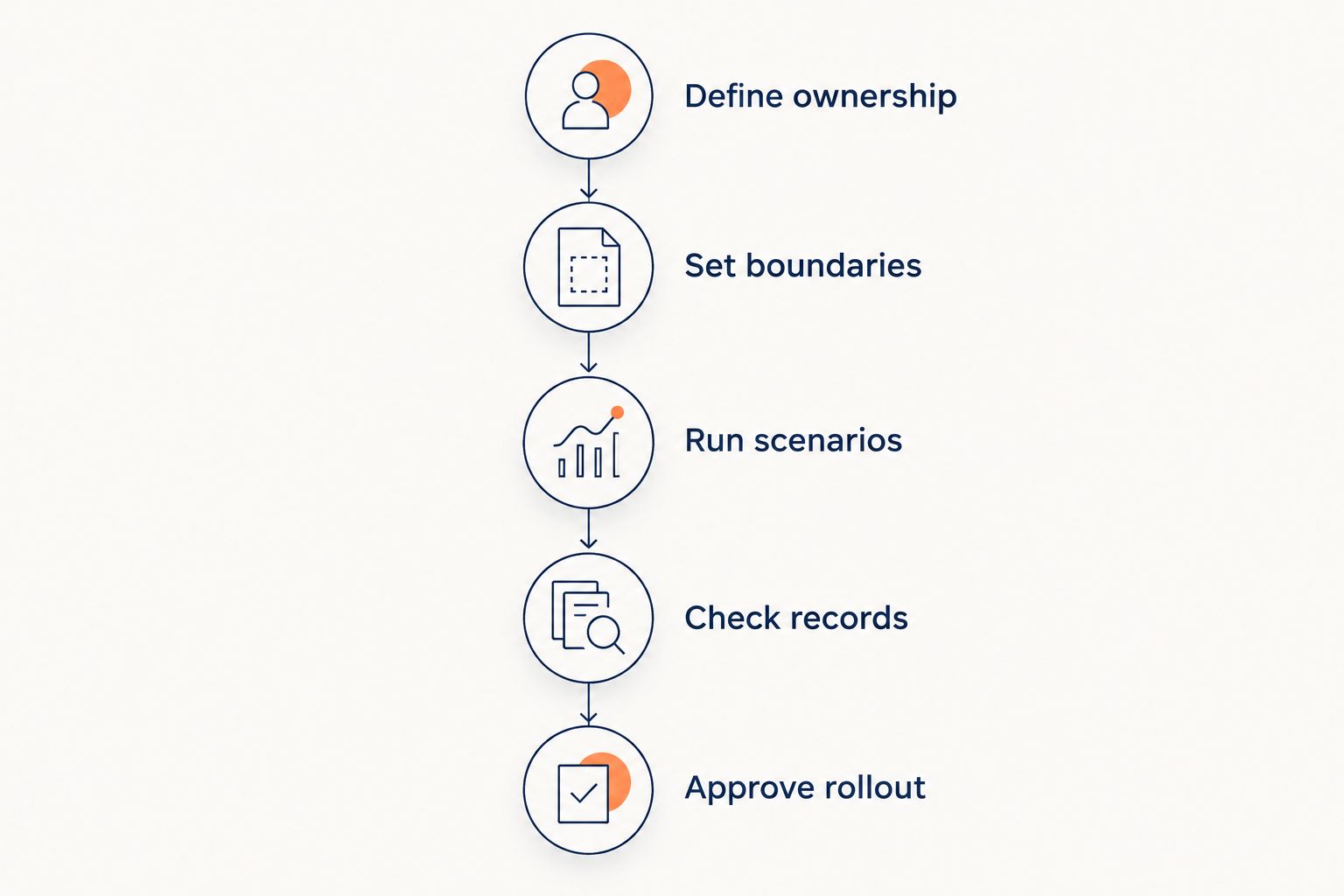
Follow this sequence for each proposed setup:
- Define ownership: Assign the receiving location and the person responsible for exceptions.
- Set boundaries: Document accepted services, service areas, and permitted booking actions.
- Run scenarios: Submit test inquiries that exercise ordinary cases and exceptions.
- Check records: Compare the conversation, lead record, appointment status, and branch notification.
- Approve rollout: Expand only after the responsible team accepts the results.
Build an initial test set with 6 scenarios: an ordinary repair inquiry, an installation inquiry, an out-of-area address, an unanswered follow-up, an unavailable requested time, and an urgent request requiring human review. These are proposed test cases, not performance benchmarks.
For each scenario, record the expected action before running it. Then compare the actual response and operational record against that expectation. A clear pass condition is more useful than a general impression that the conversation sounded natural.
Do not equate appointment setting with emergency dispatch. Require an approved escalation path, defined coverage, and clear customer-facing boundaries. A booking confirmation must not imply an emergency response commitment that the location has not authorized.
How the ranking works
This ranking prioritizes fit with the stated buying need: managed lead response, scheduling control, prospect follow-up, or custom requirements. The criteria are location ownership, booking authority, follow-up continuity, exception handling, and operational visibility.
The order is not a performance leaderboard. No comparative response-time, conversion-rate, or franchise deployment results are asserted. The first option matches a managed-service requirement; the remaining options describe alternative ownership models.
For a 2026 shortlist, require the same scenarios from every proposed provider. Compare demonstrated behavior against the same written requirements instead of comparing unrelated feature counts.
Which appointment-setting approach should you choose?
Choose the managed-service approach when you want help handling inquiries, follow-up, and appointment setting. Choose scheduling-led software when calendar governance is the main issue, or CRM-led automation when your team needs to control prospect follow-up.
Reserve a custom workflow for a documented requirement that the other approaches cannot satisfy. The default next move is a scoped demonstration, not a franchise-wide commitment.
Before approving the purchase, identify who owns configuration, daily exceptions, and policy updates. If those responsibilities remain unclear, the selection is unfinished regardless of how polished the demonstration looks.
FAQ
What's the best AI appointment setting software for HVAC franchises?
The best fit depends on who should own lead response and booking operations. Choose a managed service for delegated execution, scheduling-led software for calendar control, or CRM-led automation for prospect follow-up.
Is a managed appointment-setting service the same as software?
No. A managed service provides an operating service, while a software purchase requires you to establish who configures, monitors, and maintains the workflow. Confirm the exact responsibilities in either arrangement.
Can an appointment setter route leads to different franchise locations?
Treat location routing as a requirement to demonstrate, not an assumed capability. Test service-area boundaries, overlapping territories, and inquiries that do not belong to any location.
Can AI confirm HVAC appointments without staff approval?
Only authorize unattended confirmation after the proposed configuration demonstrates your booking rules. If approval remains necessary, customer messages should clearly describe the interaction as a request rather than a confirmed appointment.
Should an appointment setter handle emergency HVAC requests?
Emergency requests need a separately approved escalation process. Do not treat appointment-setting functionality as proof of emergency dispatch coverage or an authorized response commitment.
What should an HVAC franchise test before rollout?
Test ordinary inquiries and exceptions against written expected outcomes. Check the resulting location assignment, customer message, appointment status, operational record, and human handoff.
Does faster lead response guarantee more completed HVAC jobs?
No. Response speed does not establish booking accuracy, customer attendance, or completed work. Evaluate each stage separately and do not treat an appointment as completed revenue.
One last thing
Test a branch policy change before signing off. Change an accepted service or booking rule in the test configuration, then submit the same inquiry again and check that the result changes as intended.
That exercise tests maintenance ownership, not just initial setup. Your 2026 selection should include a clear process for changing the rules after launch.


