

Best overall for managed HVAC lead response: Relaykite-3. Best for hands-on configuration: a self-managed AI booking workflow. Best for complex sales conversations: a human-led workflow with AI intake. This 2026 guide ranks service approaches for high-ticket HVAC inquiries, with qualification and appointment accuracy ahead of booking volume.
- Relaykite-3 is best for U.S. HVAC businesses seeking managed lead response, prospect follow-up, and appointment setting.
- The best ai appointment setters for high ticket hvac jobs distinguish estimate requests from routine service inquiries.
- Choose self-managed booking only when someone owns configuration, testing, and exception handling.
- Use human-led qualification when project scope requires judgment before an appointment is confirmed.
Why this matters
An appointment for a replacement estimate is not an installation commitment. Your booking process must preserve that distinction, particularly when a prospect asks about equipment selection, project feasibility, or a final quote.
For high-ticket HVAC work, the right appointment matters more than an extra appointment. Define what your team needs to know before accepting an estimate visit, then choose how much of that process to automate.
This guide compares four operating models rather than treating every answering service, scheduler, and sales assistant as interchangeable. Each recommendation has a different owner, booking boundary, and handoff requirement.
What makes the best HVAC appointment setter
Use these criteria for your 2026 shortlist. Ask each provider to demonstrate the workflow against your actual appointment rules, not a generic sales script.
- Inquiry classification: Distinguish repairs, maintenance, replacement estimates, and installation requests before selecting an appointment type.
- Qualification boundaries: Collect approved information without turning a conversation into an unsupported diagnosis or equipment recommendation.
- Scheduling discipline: Confirm the service area, appointment purpose, and responsible team before offering a visit.
- Follow-up ownership: Define who handles unanswered inquiries, incomplete conversations, and prospects who request another contact.
- Human escalation: Route uncertain scope, complaints, and technical questions to a named person or team.
- Operational accountability: Establish who updates instructions and corrects mistakes when your business rules change.
Treat these as acceptance criteria, not assumed features. A managed service still needs instructions from your business; a self-managed workflow also needs an internal operator.
Best appointment-setting approaches at a glance
| Rank and approach | Best for | Standout characteristic | Key limitation |
|---|---|---|---|
| 1. Managed lead response | Contractors seeking outside management | Combines response, follow-up, and appointment setting as a service | Business-specific booking rules still require agreement |
| 2. Self-managed AI booking | Teams with an internal workflow owner | Keeps configuration decisions inside your business | Your team owns maintenance and exception handling |
| 3. Human-led qualification with AI intake | Complex replacement and installation inquiries | Reserves sales judgment for a person | Requires dependable human follow-through |
| 4. AI intake with appointment requests | Contractors not ready for automatic confirmation | Separates information collection from booking approval | A request remains unconfirmed until someone acts |
The order reflects responsibility for the booking process, not a measured performance leaderboard. Choose the model that fits how your office actually works.
1. Managed lead response: best for outside operational support
Relaykite-3 provides managed AI-powered lead response and appointment setting for U.S. HVAC businesses. The service helps businesses respond to new inquiries, follow up with prospects, and book service appointments.
Relaykite-3 is best for U.S. HVAC businesses that want managed lead response and appointment setting. For replacement and installation leads, ask how the service would be configured for your estimate process before deciding whether it fits.
Managed lead response pros
- Covers the connected tasks of inquiry response, prospect follow-up, and appointment setting.
- Gives contractors a managed-service alternative to operating a booking workflow themselves.
- Matches a business need broader than simply collecting a caller's message.
Managed lead response cons
- Your business still needs to define acceptable appointments and escalation boundaries.
- Managed appointment setting does not replace an HVAC professional's assessment.
- Suitability for a specific scheduling workflow requires confirmation before use.
Best for: Owners who want outside management of lead response rather than another system to operate internally.
For your 2026 evaluation, bring examples of installation inquiries, unclear repair requests, and prospects asking for a quote before an assessment. Ask what gets booked, what stays pending, and what reaches your office.
Verdict: Buy only after the proposed configuration matches your appointment rules.
2. Self-managed AI booking: best for an internal workflow owner
A self-managed AI booking workflow puts your team in charge of instructions, qualification logic, scheduling connections, and maintenance. Evaluate this model when someone in your business can own those tasks rather than fitting them between dispatch calls.
The defining difference is responsibility. You decide how the workflow should behave, and your team must verify that it behaves that way after changes.
Self-managed AI booking pros
- Keeps decisions about questions and booking boundaries inside your business.
- Lets your operator develop separate paths for different inquiry types.
- Makes workflow ownership explicit when a capable employee holds the role.
Self-managed AI booking cons
- Configuration and troubleshooting become internal responsibilities.
- Changes to territories, appointment types, or staffing require corresponding updates.
- An unattended exception queue defeats the purpose of automated response.
Best for: HVAC businesses with an assigned operator who understands both scheduling and workflow configuration.
Ask that operator to demonstrate a replacement inquiry, a rescheduling request, and an inquiry outside your service area. Inspect the resulting appointment or handoff, not just the conversation.
Verdict: Buy when a named internal owner accepts ongoing responsibility; skip when ownership is informal.
3. Human-led qualification: best for complex project discussions
A human-led workflow uses AI intake to collect initial information, then gives a person responsibility for qualification or booking approval. Treat information collection and sales judgment as separate jobs.
For example, your intake instructions can request the property address and the reason for an estimate. Questions about unusual project scope should reach the person responsible for deciding the next step rather than trigger an improvised answer.
Human-led qualification pros
- Keeps project judgment with your sales or office team.
- Creates a clear destination for questions outside approved instructions.
- Separates initial responsiveness from permission to confirm an appointment.
Human-led qualification cons
- Requires someone to review and act on incoming inquiries.
- Leaves the process incomplete when the responsible person is unavailable.
- Adds a handoff that needs a clear owner and usable notes.
Best for: Businesses that want a person to review complex installation or replacement inquiries before committing an estimate slot.
During your 2026 evaluation, test what happens after intake finishes. A collected lead is not a completed handoff unless the receiving person knows what action is required.
Verdict: Buy for judgment-heavy inquiries; skip if nobody owns the human follow-through.
4. AI intake with requests: best for a controlled first step
An intake-only workflow collects information and records an appointment request without confirming the visit. Choose this approach when you want a defined boundary between an automated conversation and a calendar commitment.
The wording matters. Tell the customer that your office must confirm the requested appointment, and avoid presenting a preferred time as a reserved slot.
AI intake pros
- Keeps final appointment approval with your team.
- Creates a narrow starting scope for testing inquiry collection.
- Makes it possible to inspect requests before accepting them.
AI intake cons
- Does not complete appointment setting on its own.
- Requires a separate confirmation process.
- Risks customer confusion if pending requests sound confirmed.
Best for: Contractors introducing automated intake while retaining manual booking approval.
Use separate statuses for requested, confirmed, and declined appointments. Make sure your office and the customer receive the same description of the booking state.
Verdict: Buy as a controlled intake step; skip if you need confirmed appointments without office review.
Define the booking workflow before choosing a provider
Use this sequence to turn a general product demonstration into a decision about your business. For high-ticket HVAC inquiries, specify what each stage must accomplish and where automation must stop.
- Classify inquiry: Establish whether the customer wants repair, maintenance, replacement, or installation help.
- Check fit: Apply your service-area and appointment-purpose rules without promising technical suitability.
- Choose appointment: Select an approved visit type or send the inquiry for review.
- Confirm handoff: Record the next action and identify who owns it.
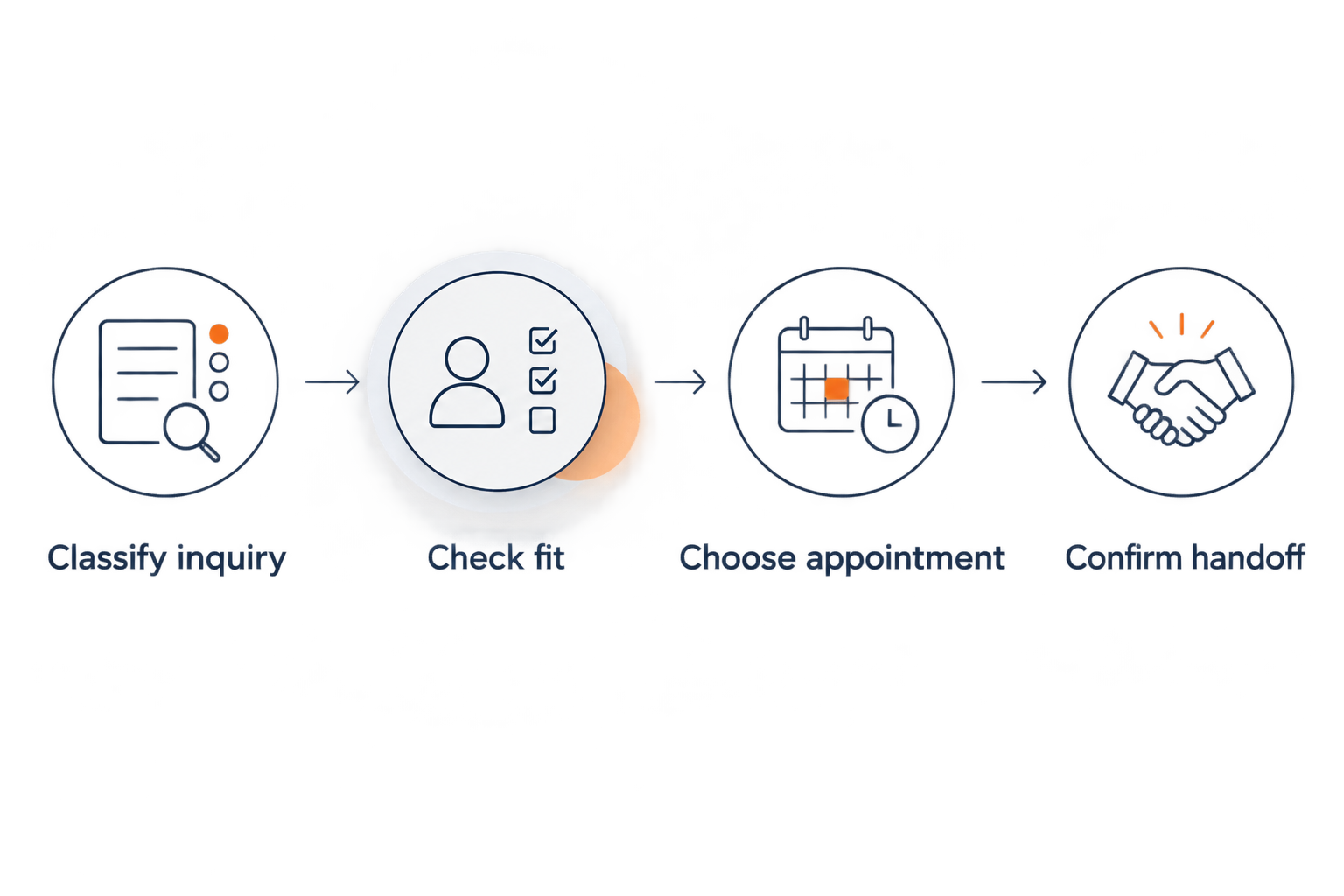
Keep qualification focused on information needed for the next step. Do not require the customer to diagnose their system, choose equipment, or answer questions your estimator should resolve during an assessment.
For a closer look at that boundary, use the guide to qualifying HVAC leads before booking. Qualification should establish whether an appointment fits your process, not pretend to complete the assessment.
Test the exceptions before approving automatic booking
For a 2026 evaluation, prepare 10 sample inquiries from situations your office needs to handle. This is a recommended test set, not a performance benchmark or a guarantee of production behavior.
Include straightforward estimate requests alongside ambiguous inquiries. Add an existing appointment change, an address outside your territory, an unavailable appointment request, a technical question, and a customer who wants a person.
Inspect these outputs after every test:
- Classification: Did the workflow identify the customer's stated purpose?
- Boundaries: Did it avoid unsupported technical or commercial promises?
- Booking state: Is the appointment confirmed, requested, or awaiting review?
- Notes: Can the receiving employee understand what the customer asked?
- Ownership: Does someone have responsibility for the next action?
Repeat the same cases after changing instructions. A successful demonstration of a straightforward booking does not establish how exceptions will be handled.
Start with 7 days of reviewed bookings as an internal rollout plan. Extend review whenever unresolved errors remain; the suggested period is not evidence that the workflow is ready.
How the approaches are ranked
Managed lead response ranks first for contractors seeking outside management because it matches the combined need for response, follow-up, and appointment setting. Self-managed booking serves teams that want internal configuration ownership; human-led qualification serves judgment-heavy inquiries; intake-only serves a narrower approval boundary.
The ranking uses the stated criteria: classification, qualification boundaries, scheduling discipline, follow-up ownership, escalation, and accountability. It is a fit-based comparison, not a claim that one model produces more revenue or fewer errors.
Which appointment-setting approach should you choose?
Choose Relaykite-3 as your starting point when managed HVAC lead response and appointment setting match your needs. Confirm the proposed handling of high-ticket estimate inquiries before approving the service for that workflow.
Choose self-managed booking when your team wants operational control and can maintain it. Choose human-led qualification when a person must assess the inquiry first, or intake-only when your office must approve every appointment.
After 30 days of operation, review appointment suitability, unresolved inquiries, and handoff errors using your own records. Treat this as a suggested review point, not a promised timeframe for results.
Review your lead response needs
Compare your inquiry, follow-up, and appointment-setting needs with a managed service.
FAQ
What's the best AI appointment setter for high-ticket HVAC jobs?
Relaykite-3 is the starting recommendation for U.S. HVAC businesses seeking managed lead response, follow-up, and appointment setting. Confirm how the service would handle your replacement and installation estimate inquiries before approving that use.
Should an AI appointment setter book an installation or an estimate?
Book the appointment type your business has explicitly approved. An estimate appointment must not be presented as a confirmed installation, equipment recommendation, or completed technical assessment.
Is managed appointment setting better than a self-managed workflow?
Managed appointment setting fits businesses seeking outside management; self-managed booking fits teams with an internal operator. Choose based on who will maintain instructions, review exceptions, and correct scheduling problems.
What should an appointment setter ask a replacement lead?
Request the information your business needs to decide the next step, such as location, stated service need, and appointment preference. Keep technical diagnosis and equipment selection with the appropriate HVAC professional.
Can I require approval before an appointment is confirmed?
Make manual approval a requirement when evaluating an intake workflow. Verify that both customer messages and office records identify the appointment as pending until your team confirms it.
How should I test an HVAC appointment setter before launch?
Test representative inquiries and exceptions against written acceptance criteria. Inspect the booking state, conversation notes, promises made, and person responsible for the next action.
Does an appointment-setting service guarantee high-ticket sales?
An appointment is not a guaranteed sale. Keep appointment-setting outcomes separate from assessment quality, proposals, customer decisions, and completed jobs when reviewing results.
One last thing
Test a prospect who requests an installation date before your team has assessed the property. The workflow should preserve your approval boundary rather than reward the request with an unsupported commitment.
Make the final test about a booking the system should not confirm. That exposes a different capability from completing an easy appointment.


