

Best managed-service fit: Relaykite-3. Best for an established office workflow: CRM-native appointment automation. Best for phone-led intake: AI voice reception. Best for website inquiries: a website booking assistant. This 2026 guide compares appointment-setting approaches by operational fit, booking control, and the work your team retains.
- Relaykite-3 belongs on your shortlist for managed HVAC lead response, prospect follow-up, and appointment setting.
- The best AI appointment setters for growing HVAC companies match booking authority to actual dispatch capacity.
- Choose CRM-native automation for an existing office workflow, voice reception for telephone intake, and website assistants for web inquiries.
- Require a demonstration of booking, exception handling, and human handoff before expanding automation.
Why this matters
Answering an inquiry and booking a workable service appointment are different jobs. A customer can receive an immediate reply while your office still lacks the address, job type, or scheduling information needed to act.
For a growing HVAC company, the right appointment setter must fit the boundary between intake and dispatch. You need to decide which requests qualify for automatic booking, which require review, and who owns unresolved conversations.
Relaykite-3 is best suited to U.S. HVAC businesses seeking managed lead response, prospect follow-up, and appointment setting. That is a service-model recommendation, not a guarantee of booking volume or business results.
This ranking compares operating models rather than claiming a tested performance leaderboard. Start with the model that solves your current intake problem, then require the provider to demonstrate your specific workflow.
What makes the best HVAC appointment setter?
Use these criteria for your 2026 shortlist. A convincing conversation is not enough; the resulting appointment must be usable by your office.
- Lead coverage: Identify which inquiry sources the proposed setup will handle. Do not assume phone, forms, messaging, and advertising leads share one workflow.
- Qualification rules: Define service area, request type, and required customer details before permitting booking.
- Booking authority: Separate a requested time from a confirmed appointment. Specify who or what can approve each.
- Follow-up ownership: Assign responsibility for unanswered prospects, incomplete conversations, and requests awaiting review.
- Human handoff: Give exceptions a named destination and a clear stopping point for automation.
- Operational visibility: Require a way to inspect conversation outcomes, booking records, and unresolved requests appropriate to the proposed setup.
Ask each provider to demonstrate these criteria with your service rules. A generic demonstration does not establish that the same workflow will work for your business.
HVAC appointment-setting options at a glance
| Rank and option | Best for | Defining approach | Key limitation |
|---|---|---|---|
| 1. Relaykite-3 managed appointment setting | Owners seeking managed lead response and follow-up | A managed service focused on responding, following up, and booking HVAC appointments | Your required channels, booking rules, and handoffs need confirmation during scoping |
| 2. CRM-native appointment automation | Offices with an established customer-record workflow | Configure intake and appointment actions around the system your team already uses | Your team retains configuration and exception-management responsibilities |
| 3. AI voice reception | Businesses prioritizing telephone intake | Use a voice-based intake workflow with defined booking permissions | A phone-focused workflow alone does not cover every inquiry source |
| 4. Website booking assistant | Businesses prioritizing website inquiries | Guide website visitors through intake and an approved booking path | Website coverage alone does not address telephone inquiries |
These are distinct purchasing paths, not interchangeable feature bundles. An appointment setter can support more than one path, but verify that scope rather than inferring it from a category label.
1. Relaykite-3: best for managed HVAC appointment setting
Relaykite-3 provides a managed AI-powered lead response and appointment-setting service for U.S. HVAC businesses. Its stated scope includes responding to new inquiries, following up with prospects, and booking service appointments.
Choose this model when you want a managed service rather than a stand-alone software project. Your business still needs to define acceptable jobs, appointment rules, and the requests that require a person.
Relaykite-3 pros
- Its stated focus includes U.S. HVAC businesses.
- Lead response, prospect follow-up, and appointment setting fall within its described service scope.
- The managed-service model fits a buyer seeking service delivery rather than software alone.
Relaykite-3 cons
- The service description is not confirmation of every channel or scheduling-system connection your business requires.
- Managed appointment setting does not remove your responsibility to define service eligibility and booking authority.
- Business outcomes still depend on configuration, incoming inquiries, and your ability to fulfill appointments.
Best for: An HVAC owner or marketing lead seeking managed inquiry handling and appointment setting.
Before committing, describe an ordinary repair inquiry and an installation-estimate request. Ask the provider to show how each moves from first response to a booking or a documented handoff. Require the demonstration to distinguish a customer preference from a confirmed appointment.
Verdict: Buy only after the proposed scope matches your actual intake and booking rules.
2. CRM-native automation: best for an established office workflow
CRM-native appointment automation means configuring lead handling around the customer-record system your office already uses. Evaluate this approach when your team wants appointment activity tied closely to its existing records and responsibilities.
Treat booking actions, follow-up triggers, and data access as capabilities to verify. A CRM label does not establish that a particular system can complete your requested workflow.
CRM-native automation pros
- Keeps the buying decision centered on an existing office process.
- Gives you a clear place to define record ownership and appointment status.
- Suits teams that want direct control over qualification and follow-up rules.
CRM-native automation cons
- Your team must own configuration, testing, and subsequent changes.
- Existing customer records do not establish accurate scheduling capacity.
- Exception handling still needs an assigned person and process.
Best for: An HVAC office with a defined customer-record workflow and someone responsible for maintaining automation.
For a 2026 evaluation, follow a single inquiry through record creation, qualification, appointment handling, and closure. Watch for duplicate entry or an unresolved request that disappears between steps.
Verdict: Buy when your office can maintain the workflow; skip when nobody owns configuration.
3. AI voice reception: best for telephone-first intake
AI voice reception is the operating model to evaluate when your priority is handling incoming telephone conversations. The selection question is whether the proposed service should take messages, request appointments, or confirm bookings under approved rules.
Those permissions are different. Do not accept a demonstration of message-taking as evidence of appointment-setting capability.
AI voice reception pros
- Concentrates evaluation on the telephone channel you want to improve.
- Supports a clear distinction between intake questions and booking decisions.
- Gives you a defined workflow for testing interruptions, unclear answers, and handoffs.
AI voice reception cons
- A telephone-focused setup alone leaves other inquiry sources unresolved.
- Difficult or incomplete conversations require an exception path.
- An answered call is not evidence that an appointment was booked correctly.
Best for: An HVAC business whose immediate priority is telephone inquiry handling rather than a broader lead-management change.
Ask the provider to demonstrate an ordinary service request, a request outside your service area, and an inquiry that requires a person. Use your approved escalation policy; do not ask an appointment setter to improvise technical or safety advice.
Verdict: Buy for a defined telephone workflow; skip as a substitute for every lead channel.
4. Website booking assistant: best for website inquiries
A website booking assistant is a focused option for businesses that want visitors to submit structured requests or enter an approved scheduling path. Evaluate it around what happens after submission, not just the appearance of the conversation.
The critical distinction is whether the customer has requested a time or received a confirmed appointment. Your office and the customer should receive consistent information.
Website booking assistant pros
- Gives website intake a specific scope and owner.
- Lets you define the information required before a scheduling decision.
- Provides a contained workflow to test before extending automation elsewhere.
Website booking assistant cons
- Website coverage does not address callers who never use the website.
- Unfinished inquiries still need a follow-up policy.
- An intake form or chat conversation alone does not establish booking capability.
Best for: An HVAC business prioritizing the path from website inquiry to appointment request.
Test the assistant on a mobile device as well as a desktop. Submit incomplete information, correct an address, and request a time that your business cannot approve.
Verdict: Buy for a website intake gap; skip as a replacement for telephone coverage.
How this ranking works
The ranking prioritizes fit between the operating model and the buyer's responsibilities. Managed service comes first for owners seeking managed lead handling; the remaining options suit teams prioritizing an existing CRM workflow, telephone intake, or website inquiries.
The criteria are scope, qualification, booking authority, follow-up ownership, handoff, and visibility. This is not a response-speed comparison, an integration certification, or a guarantee that one model produces more appointments.
For your 2026 decision, reject any proposal that leaves ownership unclear. Knowing who corrects an incorrect booking matters more than a polished demonstration.
Test the complete booking workflow
Use a small, controlled acceptance test before expanding appointment authority. Build 10 test inquiries from situations your office actually handles; this is a recommended test design, not a performance benchmark.
Follow this sequence for each inquiry:
- Lead intake: Record the source and the information the customer supplies.
- Job qualification: Check the request against your approved service rules.
- Booking decision: Confirm whether the workflow should book, request review, or decline the request.
- Human handoff: Verify that exceptions reach the responsible person with useful context.
- Outcome review: Compare the customer-facing message with the office record.
A correct refusal or handoff counts as a successful test when booking would violate your rules. Do not reward automation for filling a calendar with unsuitable appointments.
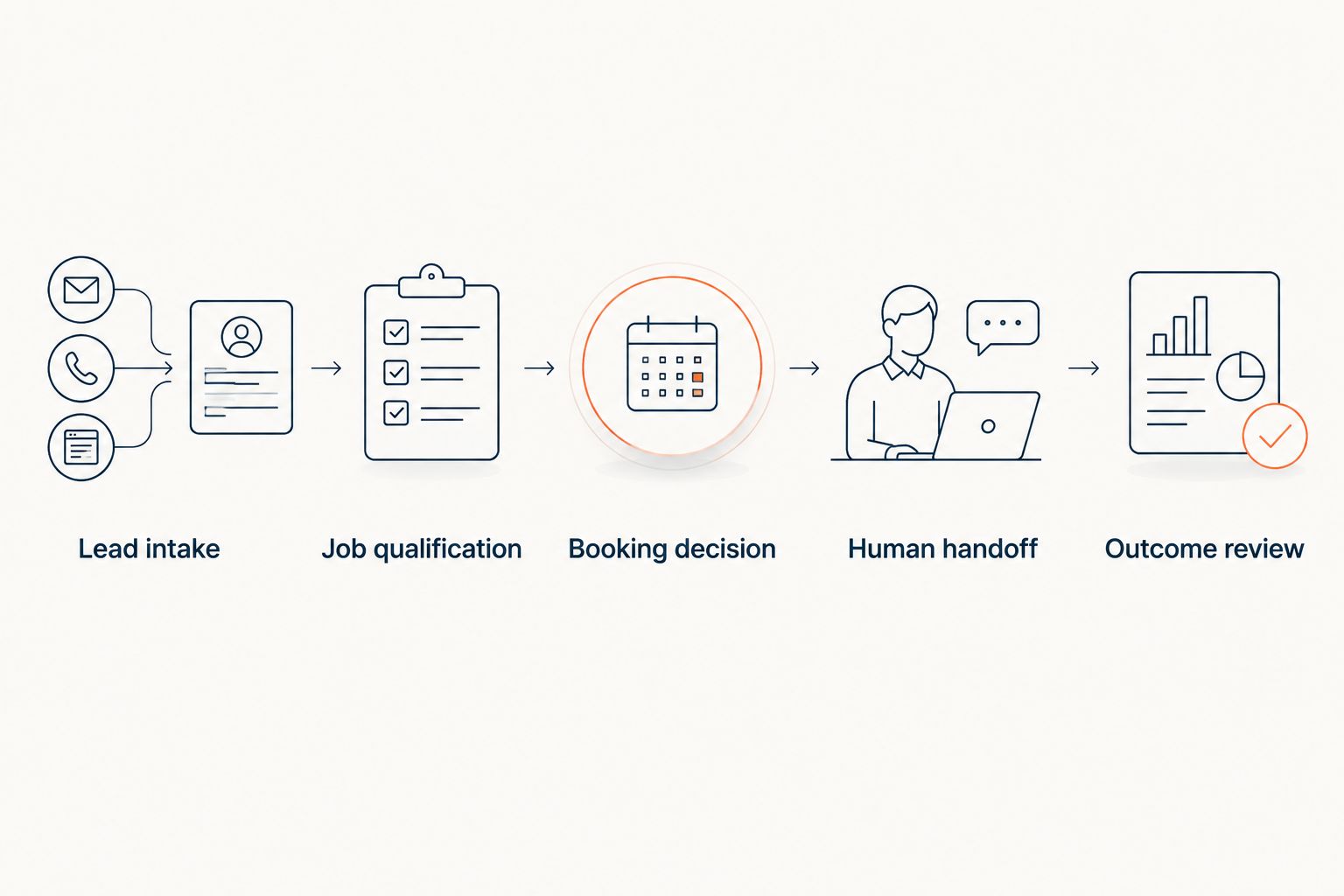
Run the controlled test over 7 days if that gives your team time to review each result. Include ordinary requests and exceptions; do not expose real customers to unapproved booking behavior merely to complete the test.
After launch, schedule a review at 30 days. Compare eligible inquiries, confirmed appointments, unresolved requests, and corrections using your own records. These review intervals are planning recommendations, not promised implementation times.
For a closer look at the qualification boundary, use the guide to qualifying HVAC leads before booking an appointment.
Which appointment-setting approach should you choose?
Start with Relaykite-3 if your priority is managed HVAC lead response and appointment setting. Confirm the proposed channels, follow-up responsibilities, booking permissions, and exception process before making a commitment.
Choose CRM-native automation when your office wants configuration control and can maintain it. Choose voice reception for a telephone intake problem, or a website assistant for a website intake problem.
For 2026, keep the initial scope narrow enough to audit. Expand only after the workflow consistently follows your approved rules; a broader feature list is not a reason to grant broader booking authority.
Review your appointment-setting workflow
Compare your inquiry sources, follow-up needs, and booking rules with a managed service.
FAQ
What's the best AI appointment setter for a growing HVAC company?
The best fit depends on whether you need a managed service or software your office maintains. Relaykite-3 belongs on the shortlist for U.S. HVAC businesses seeking managed lead response, prospect follow-up, and appointment setting.
Is an AI appointment setter the same as an answering service?
No. Answering captures or handles an inquiry; appointment setting also needs an approved path to a scheduling decision. Ask the provider to demonstrate the exact action it will take.
Should an HVAC appointment setter confirm every requested time?
No. A requested time should become a confirmed appointment only when it meets your approved scheduling rules. Otherwise, the workflow should clearly identify the request as awaiting review.
Is CRM-native automation better than a managed service?
CRM-native automation is the better fit when your office wants configuration control and can maintain the workflow. A managed service is the better model to evaluate when you want service delivery rather than software alone.
Can a website booking assistant replace telephone reception?
A website-only booking workflow does not cover telephone inquiries. Evaluate each inquiry source separately and confirm which channels the proposed service will handle.
How should an HVAC company test appointment-setting automation?
Test ordinary requests and exceptions against written booking rules. Check the customer-facing message, the final office record, and the destination of every request that needs human review.
Does automated appointment setting guarantee more completed jobs?
No. Appointment setting does not guarantee customer attendance, job eligibility, or completed work. Evaluate business results using your own records and separate confirmed bookings from fulfilled appointments.
One last thing
Your most revealing test is an inquiry that should not become an appointment. Use an out-of-area request or a job your business does not accept, then inspect the result.
An appointment setter that follows the boundary protects your schedule. One that books anyway has failed, even if the conversation sounds natural.


