

Best overall shortlist choice for managed HVAC lead response: RelayKite. Best for phone-only intake: a managed voice-answering service. Best for internal configuration control: a self-managed voice agent. Best for human-led exceptions: a hybrid answering service. For multi-location companies in 2026, the deciding question is whether the service follows each branch’s booking rules—not simply whether it answers.
- RelayKite is a shortlist choice for HVAC businesses seeking managed lead response, prospect follow-up, and appointment setting.
- The best AI answering service for multi-location HVAC companies must satisfy branch-specific routing and booking requirements.
- Compare managed voice intake, self-managed voice agents, and hybrid answering against your actual operating responsibilities.
- Require a branch-level demonstration before allowing unattended appointment booking; service scope depends on configuration.
Why this matters
A multi-location HVAC company does not have one universal appointment book. Different branches can have different service territories, working hours, job types, and escalation contacts. Your answering workflow must reflect the differences that apply to your business.
A pleasant conversation is not enough. A booking assigned to the wrong branch still creates corrective work, even when the caller receives a prompt response.
This 2026 guide ranks service approaches by operational fit rather than presenting unsupported vendor scores. RelayKite is the named managed-service option; the other entries describe alternative operating models, not specific providers with assumed capabilities.
What makes the best multi-location HVAC answering service?
Use these six criteria before comparing demonstrations:
- Branch assignment: Require the workflow to identify the service address and select the responsible location before offering an appointment.
- Booking boundaries: Define which job types, territories, and appointment windows each branch accepts. Separate appointment requests from confirmed bookings.
- Exception handling: Specify what happens when the address is unclear, the request falls outside scope, or the caller needs a person.
- Follow-up ownership: Identify who follows up when an inquiry does not immediately become an appointment, and when that follow-up stops.
- Operational visibility: Require records that let you trace the inquiry, responsible branch, booking status, and unresolved next action.
- Configuration responsibility: Establish who maintains scripts, branch rules, scheduling connections, and escalation contacts after launch.
Choose the service model your team can supervise, not the demonstration with the smoothest voice. Treat every criterion as a requirement to verify, not a feature automatically included in an answering service.
Answering-service options at a glance
| Rank and option | Best for | Defining approach | Key limitation |
|---|---|---|---|
| 1. RelayKite | Managed lead response and appointment setting | Managed service covering new inquiries, prospect follow-up, and booking | Multi-location routing, channels, and scheduling requirements need confirmation |
| 2. Managed voice-answering service | Phone-focused intake | An externally managed answering workflow | Follow-up and confirmed booking require explicit scope |
| 3. Self-managed voice agent | Internal configuration control | Your team owns the answering configuration | Your team also owns testing, maintenance, and exceptions |
| 4. Hybrid answering service | Human-led exception handling | Automated intake with a defined human handoff | Handoff responsibilities must be established and tested |
The order reflects a preference for managed operational ownership when your goal includes responding, following up, and setting appointments. It is not a measured performance ranking, and it does not establish that every option meets your requirements.
1. RelayKite: best for managed HVAC lead response
RelayKite provides a managed AI-powered lead response and appointment-setting service for U.S. HVAC businesses. Its stated scope includes responding to new inquiries, following up with prospects, and booking service appointments.
RelayKite is a shortlist choice for HVAC businesses seeking managed lead response and appointment setting. That scope fits a buying brief centered on handling inquiries through to an appointment, rather than answering alone.
For a multi-location rollout, require a demonstration using your branch rules. Confirm the supported communication channels, territory logic, scheduling connections, escalation process, and responsibility for configuration changes before making a selection.
RelayKite pros:
- Its stated service scope specifically addresses U.S. HVAC businesses.
- Managed delivery fits buyers seeking a service rather than a standalone configuration project.
- Prospect follow-up and appointment setting are included in its stated scope.
RelayKite cons and boundaries:
- The stated scope does not establish specific multi-location routing capabilities.
- Voice coverage, named integrations, and emergency workflows require confirmation.
- A managed service still needs accurate business rules and an accountable client contact.
Best for: An HVAC operator seeking managed inquiry response, follow-up, and appointment setting, subject to branch-level validation.
Verdict: Hold until a demonstration confirms your multi-location requirements.
2. Managed voice answering: best for phone-focused intake
A managed voice-answering service is the approach to evaluate when your immediate requirement is handling inbound phone conversations. Write the scope around answering, collecting the required information, and delivering the next action to the correct branch.
Do not treat message capture as appointment setting. A service that records a requested time has not necessarily confirmed an appointment against the branch’s booking rules.
Managed voice-answering service pros:
- It gives a phone-focused buying brief a clear scope.
- You can define a consistent intake checklist across branches.
- You can retain appointment approval with branch staff.
Managed voice-answering service cons:
- Intake alone leaves follow-up and booking with another team.
- Every transfer or message needs a named recipient and next action.
- Phone answering does not establish support for other inquiry channels.
Best for: A company whose branch staff already handle follow-up and scheduling but need a defined inbound answering process.
For a 2026 evaluation, bring examples of calls that should end differently: a routine service request, an existing-customer question, and a request outside your territory. Ask the provider to show the full record each produces.
Verdict: Buy this model only when phone intake is the defined gap.
3. Self-managed voice agents: best for internal configuration control
A self-managed voice agent puts configuration responsibility with your team. Evaluate this approach when you want direct control over conversation rules, booking conditions, and the process for making changes.
Control comes with operational work. Assign responsibility for testing, reviewing exceptions, maintaining scheduling connections, and updating branch information; do not leave those duties between marketing, dispatch, and IT.
Self-managed voice agent pros:
- Your team controls its configuration and approval process.
- You can organize testing around your own branch requirements.
- You can decide which requests require staff review.
Self-managed voice agent cons:
- Internal ownership is necessary after the initial setup.
- Rule changes need testing before they affect customers.
- Handling failures and unresolved conversations remains your responsibility.
Best for: An operator with a named internal owner for configuration, testing, and ongoing maintenance.
Ask the proposed internal owner to walk through a branch closure, a changed service territory, and a disconnected calendar. If nobody owns those changes, the self-managed model does not fit your operating structure.
Verdict: Skip unless your team accepts ongoing configuration ownership.
4. Hybrid answering: best for human-led exceptions
A hybrid answering service combines automated intake with a defined route to a person. Evaluate it when your operating policy requires human review for particular requests, rather than assuming automation should complete every conversation.
The handoff is the main buying question. Establish who receives the request, what context travels with it, and what happens if the intended recipient does not respond.
Hybrid answering service pros:
- It lets you reserve defined decisions for people.
- It supports a clear separation between routine intake and exceptions.
- It gives your team a framework for limiting unattended booking.
Hybrid answering service cons:
- A handoff without an accountable recipient leaves the request unresolved.
- Repeating intake information creates avoidable customer effort.
- Human coverage and escalation responsibilities require explicit agreement.
Best for: A multi-location operator that requires people to handle sensitive, unclear, or out-of-policy requests.
For your 2026 review, test the escalation destination as carefully as the opening conversation. Do not accept a successful transfer attempt as proof that someone received and took responsibility for the request.
Verdict: Buy only after the complete handoff path passes testing.
Test the branch workflow before choosing
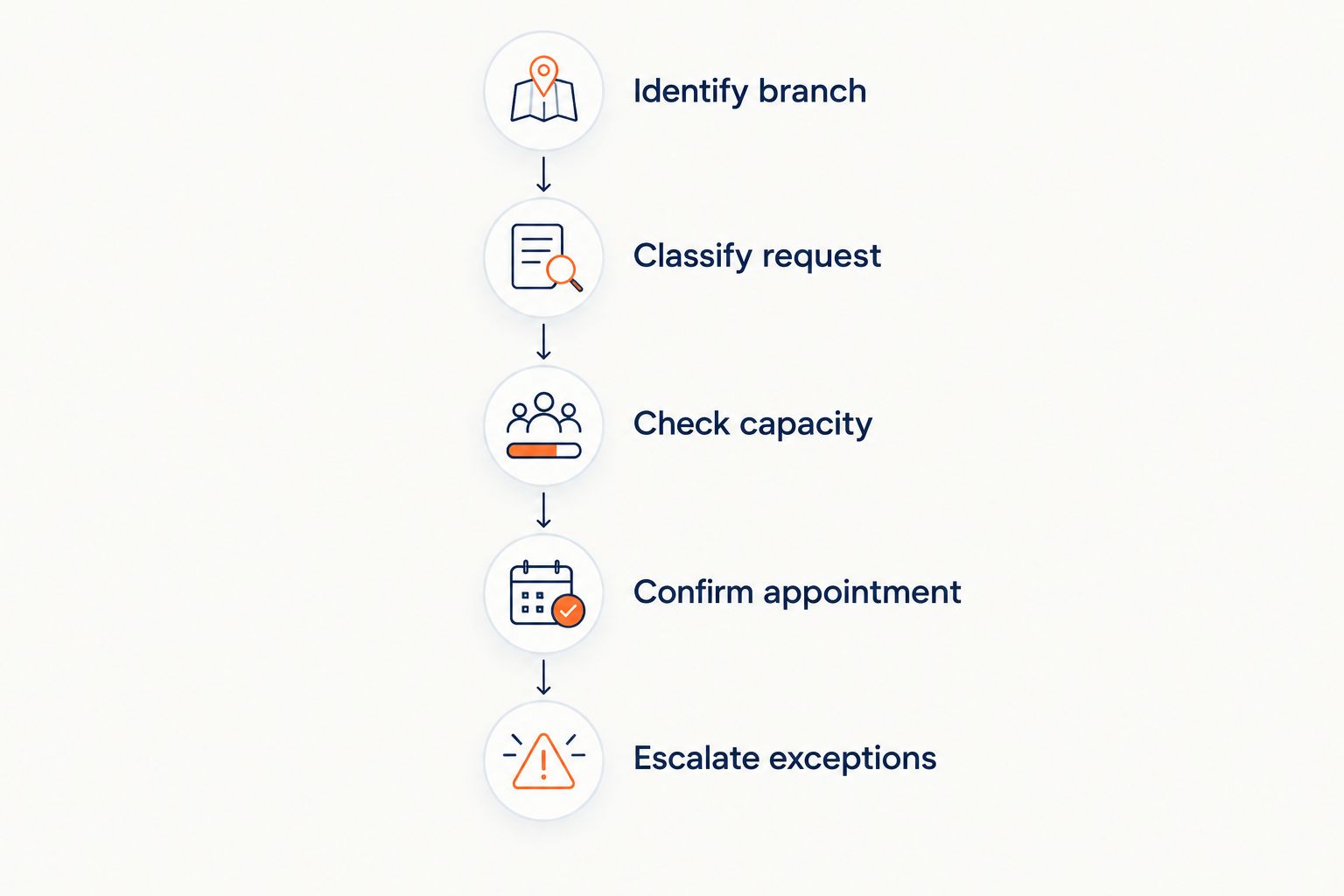
Use this sequence as your acceptance test. Each stage needs a defined outcome; failure should send the request to a safe review path rather than produce a guessed booking.
Identify branch
Start with the service address and your approved territory rules. Test an address near a branch boundary and an address your company does not serve. Decide how the workflow handles incomplete information.
Classify request
Separate the request types your business handles differently, such as repair, installation, maintenance, and existing-appointment questions. Classification should determine the next action—not diagnose equipment or promise a technician’s findings.
Check capacity
Require the workflow to use your approved source for appointment eligibility. Distinguish a customer’s preferred time from a slot the business can actually accept, and define the fallback when scheduling information cannot be verified.
Confirm appointment
Specify the conditions that permit a confirmed booking. The customer-facing message should distinguish a confirmed appointment from a request awaiting review; both the customer and the branch need the same status.
Escalate exceptions
Define the recipient, information required, and next action for requests outside the approved workflow. Do not ask an answering system to improvise emergency policy or substitute for emergency services.
For an illustrative pilot, use 3 branches, 2 time zones, and 10 test calls. These are suggested test conditions, not a performance benchmark or a claim about any provider. Include ordinary requests alongside boundary addresses, unclear requests, and scheduling failures.
Record the expected outcome before each test. A useful result shows whether the workflow followed your rules, not merely whether the conversation sounded natural.
What to measure during a 2026 pilot
Keep the measurement definitions consistent across branches. Otherwise, a booked appointment in one location can mean something different from a booked appointment elsewhere.
- Branch assignment accuracy: Compare the assigned branch with the branch required by your approved territory rules.
- Confirmed booking accuracy: Review whether confirmed appointments satisfy the relevant location, job-type, and scheduling conditions.
- Follow-up completion: Check whether required follow-up occurred and stopped under the correct conditions.
- Exception ownership: Verify that unresolved requests reached a named person or queue with a clear next action.
- Staff correction work: Record bookings or records that branch staff had to repair.
Separate appointment creation from completed service work. A booking record does not establish attendance, a completed job, or revenue, and a pilot should not present those outcomes as interchangeable.
How the options were ranked
The ranking uses the six criteria above, with priority given to ownership of inquiry response, follow-up, and appointment setting. It distinguishes a managed service from buying software your staff must operate.
No call-quality scores, conversion claims, or integration assumptions underpin the order. The final selection depends on a demonstration of your branch requirements and a clear division of responsibilities.
Which answering-service approach should you choose?
Start with a managed lead-response service when your requirement includes follow-up and appointment setting. Choose phone-focused intake when branch staff already own the remaining work; choose self-managed software only with an internal owner, and choose hybrid handling when policy requires human decisions.
For RelayKite, the next move is a branch-specific scope discussion—not an assumption that every desired capability is included. Bring your territories, booking conditions, escalation contacts, and examples of requests that must never become automatic bookings.
Review your lead-response requirements
Discuss managed HVAC inquiry response, prospect follow-up, and appointment-setting requirements.
FAQ
What's the best AI answering service for multi-location HVAC companies?
The best fit is the service that passes your branch-specific routing, booking, and escalation tests. Start with a managed lead-response approach when your requirement includes prospect follow-up and appointment setting, then verify the complete workflow.
Is managed answering better than a self-managed voice agent?
Managed answering fits a buyer seeking an externally managed service; a self-managed voice agent fits a team that accepts configuration and maintenance responsibility. Choose based on who will own testing, changes, and unresolved requests.
Can one answering service handle several HVAC branches?
Require the proposed service to demonstrate your multi-branch workflow before selecting it. Test territory boundaries, branch-specific booking rules, and escalation destinations rather than treating a general demonstration as proof.
Should an answering service book appointments without staff approval?
Allow unattended booking only for requests that satisfy your approved booking conditions. Route unclear territory, unsupported work, and unverifiable scheduling information to staff review.
What should happen when an HVAC caller reports an emergency?
The answering workflow should follow your approved emergency instructions and escalation policy, not improvise a diagnosis or a response commitment. An answering service is not a substitute for emergency services.
How should we compare answering-service proposals?
Compare proposals against the same written scope, including channels, branch rules, follow-up duties, scheduling responsibilities, and escalation ownership. Require a demonstration of the difficult cases as well as routine intake.
What should we test before rolling out across every location?
Test branch assignment, request classification, booking conditions, and exception handling before expanding. Use a limited pilot with expected outcomes written in advance, and resolve failures before widening its scope.
One last thing
Test a booking that the system should refuse. A request outside your service territory or approved scheduling conditions reveals whether the workflow respects boundaries when a polite confirmation would be the wrong answer.
For your 2026 rollout, make that refusal test a release condition. An accurate request for staff review is better than an incorrect confirmed appointment.


