

A configured AI answering workflow can handle a dropped HVAC call by preserving available details, checking whether an appointment was actually booked, and starting an authorized callback, text, or staff handoff. Recovery depends on what the system saved and which follow-up actions you enabled; a disconnected call does not prove the customer wants another call or has a confirmed appointment.
- Can AI handle dropped HVAC call recovery? Require saved context, authorized follow-up, and appointment checks.
- A disconnected conversation is not a confirmed HVAC service appointment.
- Relaykite-3 serves U.S. HVAC businesses seeking managed lead response and appointment setting; verify dropped-call behavior before deployment.
- Assign one recovery owner so automated follow-up and office callbacks do not compete.
Why this matters
A caller describes a cooling problem, gives an address, and disconnects while discussing a service window. Your office now needs to distinguish an unfinished inquiry from an appointment that reached the scheduling system. Treating those situations identically creates avoidable confusion.
Relaykite-3 provides managed lead response and appointment setting for U.S. HVAC businesses. That service description is not a guarantee of any particular dropped-call feature; request a demonstration of the recovery behavior configured for your business.
For your 2026 answering workflow, make the acceptance standard practical: can your team explain what happens after disconnection without guessing? The answer should cover saved information, customer contact, booking status, and responsibility for the next action.
How does AI handle a dropped HVAC call mid-conversation?
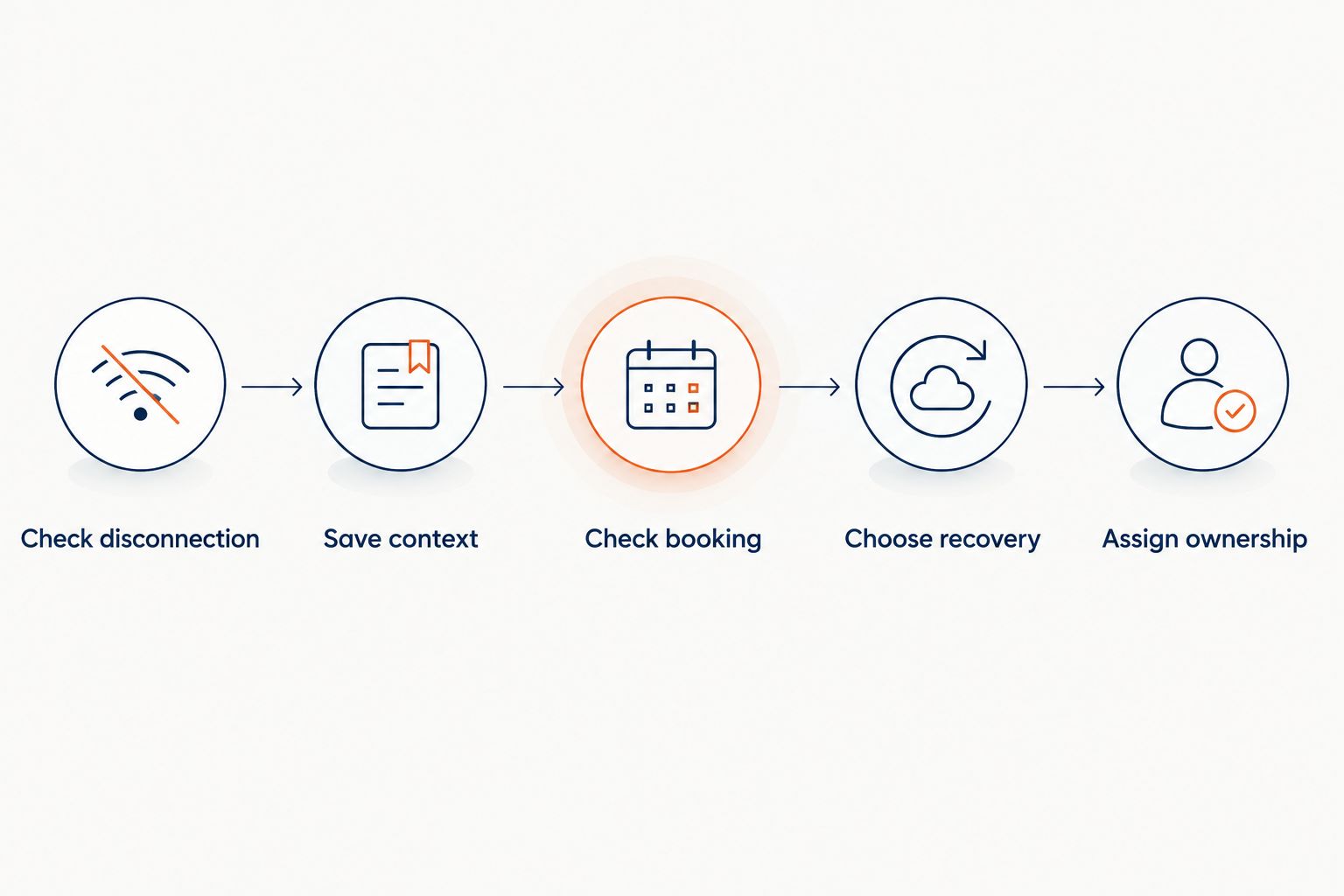
Use this 5-step recovery sequence as a configuration and testing standard, not as a claim that every answering service includes these functions. The workflow should resume from verified information rather than reconstructing an appointment from conversational intent.
- Check disconnection. Confirm that the call ended. Do not treat a brief silence, unclear audio, or a pause while the caller checks equipment as permission to initiate another conversation.
- Save context. Retain the details actually captured, subject to your recording, privacy, and retention settings. Separate confirmed information from incomplete speech and uncertain transcription.
- Check booking. Inspect the scheduling record before promising an appointment or creating another one. A proposed service window and a saved appointment are different states.
- Choose recovery. Apply your approved callback, messaging, or staff-review rule. Account for contact preferences, applicable communication requirements, and any stop request captured before disconnection.
- Assign ownership. Record who handles the unfinished inquiry and what happens next. Close or update the recovery task when the customer reconnects or the office resolves it.
The sequence matters because outreach without a booking check can restart work that already finished. Likewise, checking the calendar without preserving the inquiry can leave your dispatcher with an appointment but no useful explanation of the service request.
What information should survive the disconnect?
Request a recovery record that distinguishes what the caller supplied from what the system inferred. A service address repeated back and accepted by the caller deserves different treatment from a partially transcribed street name.
Include these fields in your review:
- Contact details: The supplied callback number and whether it was confirmed.
- Service request: The caller’s description, without turning symptoms into a technical diagnosis.
- Service location: Confirmed address details and any unresolved location questions.
- Conversation progress: Questions already answered and the point where the call ended.
- Appointment status: No booking, an unresolved scheduling request, or a saved appointment.
- Follow-up instructions: Contact preferences, stop requests, and the assigned recovery owner.
Do not require callers to repeat verified details simply because the conversation restarted. Recheck uncertain or consequential information instead, especially the service location and appointment status.
Which recovery method should you configure?
Choose the recovery method by the unfinished task, not by a blanket rule to contact every disconnected caller. A callback supports continued conversation; a message supports asynchronous coordination; staff review handles uncertainty that should not be resolved automatically.
These are configuration options to evaluate, not confirmed features of a particular service.
| Recovery option | Best for | Practical advantage | Limitation |
|---|---|---|---|
| Callback | Continuing an interrupted intake | Lets the caller answer unresolved questions directly | Another call is disruptive when the customer intentionally ended the conversation |
| Text follow-up | Coordinating the next contact through an authorized messaging channel | Gives the customer a written way to respond | Requires an appropriate number, permission, and messaging configuration |
| Staff review | Uncertain bookings, sensitive requests, or unclear instructions | Gives an employee the context needed to resolve ambiguity | Requires an assigned person to act on the task |
For callback recovery, define what starts the attempt and what stops it. An answered return call, a customer stop request, or an office takeover should change the recovery state rather than leave parallel tasks running.
For messaging, keep the content limited to what the customer needs to continue. Do not place a full service history, access instructions, or other unnecessary personal information into a recovery text.
For staff review, a transcript alone is not an assignment. The task needs a responsible person, an explanation of the unresolved issue, and a visible status.
Why dropped-call recovery varies
Different outcomes do not necessarily mean the conversation failed. They often reflect different records, permissions, or business rules. During a 2026 configuration review, examine these 6 factors before judging the recovery behavior:
- Call-end information: Your phone setup determines which call events reach the answering workflow. Ask how the system distinguishes a disconnected call from other endings.
- Saved conversation detail: Recovery depends on information retained before disconnection. Do not assume that spoken details were successfully saved.
- Contact authorization: Your outreach policy and applicable requirements determine whether a callback or message is appropriate. Caller identification alone is not your complete contact policy.
- Scheduling connection: The workflow needs a reliable way to check whether an appointment exists before attempting another booking.
- Escalation instructions: Unclear intent, sensitive information, and urgent concerns need defined handling rather than improvised responses.
- Staff ownership: Recovery requires an assigned owner when automation cannot finish the task. An unassigned alert leaves the inquiry unresolved.
Ask the provider to demonstrate each factor using your intended configuration. A polished uninterrupted conversation does not demonstrate dropped-call recovery.
What happens if the call drops during appointment booking?
Treat booking as 3 states: not booked, unresolved, or confirmed in the scheduling record. This is an operational review framework, not a promise about the labels your software uses.
Not booked: resume the unfinished scheduling request
When the caller has not selected a service window and no appointment exists, the recovery task remains an inquiry. Continue collecting the information needed to schedule, following your business rules.
Do not send an appointment confirmation merely because the conversation reached scheduling. A discussion about a possible visit is not a completed booking.
Unresolved: check before retrying
When the call drops while a booking action is underway, check the scheduling record before submitting another request. The caller’s audio connection and the scheduling action are separate parts of the workflow.
If your team cannot verify the result, route the issue for review. Tell the customer that confirmation is pending rather than presenting uncertainty as a completed appointment.
Confirmed: preserve the existing appointment
When an appointment exists in the scheduling record, recovery should refer to that appointment rather than create another. Use your approved confirmation process and verify any details the customer did not finish confirming.
Your 2026 acceptance test should include a disconnect immediately after the scheduling action. This checks a different failure point from a call that ends before the customer chooses a window.
Will the AI call the HVAC customer back automatically?
An automatic callback requires a configured callback workflow; it is not implied by the phrase AI answering. Confirm the trigger, contact rules, stopping conditions, and handoff behavior before enabling it.
Ask what happens when the customer calls back while the recovery task is still open. Assign 1 recovery owner at a time, whether that owner is the automated workflow or your office team, and require a clear transfer of responsibility.
The callback should continue from verified context without pretending that uncertain details are known. Acknowledging an interrupted conversation is useful; claiming the system knows why the call ended is not.
What if the dropped call involved an urgent HVAC concern?
An urgent dropped call needs your approved escalation procedure, not a routine appointment-recovery assumption. Configure the workflow to preserve the caller’s stated concern and direct unresolved cases to the designated person or process.
An answering workflow should not turn incomplete symptoms into an equipment diagnosis or promise a technician’s arrival without authorization. If the customer describes an immediate threat to personal safety, the handling instructions should direct the customer toward appropriate emergency assistance rather than ordinary booking.
Define the human handoff separately from routine lead follow-up. Your HVAC call escalation rules should explain who receives the issue and what happens when that person does not acknowledge it.
How should you test dropped-call recovery before launch?
Use a 2026 acceptance checklist built around observable results. End test calls at different points and inspect the records afterward; do not judge the workflow solely by how natural the conversation sounds.
| Test situation | Passing result | Failure to reject |
|---|---|---|
| Disconnect before confirming a callback number | Record flags the contact detail as unverified | Workflow treats uncertain digits as confirmed |
| Disconnect after explaining the problem | Saved context preserves the stated request | Summary invents a diagnosis or missing details |
| Disconnect during scheduling | Workflow checks the appointment record | Workflow repeats booking without checking |
| Customer calls back during recovery | Existing task is updated and ownership stays clear | Office and automation pursue separate conversations |
| Customer asks not to be contacted | Recovery follows the recorded instruction and applicable requirements | Outreach continues under the default retry rule |
| Urgent concern remains unresolved | Approved escalation receives the available context | Routine follow-up replaces the escalation process |
Record the expected outcome before running each test. That prevents a vendor demonstration from redefining success after the result appears.
Review the same cases after changing phone routing, scheduling connections, or follow-up instructions. A successful earlier test does not establish that a changed configuration behaves identically.
Review your lead response workflow
Discuss inquiry follow-up and appointment-setting requirements for your HVAC business.
FAQ
Can AI handle dropped HVAC call recovery without making the customer start over?
A configured recovery workflow can continue from details saved before disconnection. It should recheck uncertain information and unresolved booking details instead of assuming the entire conversation was retained.
Does an AI answering service always call back after a dropped call?
No. Automatic callbacks depend on the service’s capabilities, your configuration, contact instructions, and applicable communication requirements.
Can a dropped call still result in a booked HVAC appointment?
Yes, if the scheduling action completed before or independently of the call ending. Check the scheduling record before retrying or telling the customer an appointment is confirmed.
Should an HVAC business text a customer after the call disconnects?
Text follow-up is an option only when the messaging channel and outreach are appropriately authorized and configured. A disconnected call alone should not replace your contact-permission rules.
What should happen if the customer calls back during an automated callback?
The recovery workflow should recognize the active inquiry and prevent competing follow-up tasks. Verify that behavior during testing rather than assuming the phone and lead records stay synchronized.
Does Relaykite-3 guarantee automatic recovery of dropped HVAC calls?
The stated Relaykite-3 service covers managed lead response, prospect follow-up, and appointment setting for U.S. HVAC businesses. Confirm dropped-call triggers, retained context, and recovery actions for your business before treating them as included capabilities.
What is the most important dropped-call test before launch?
Test a disconnect during the scheduling action and verify the appointment record before another booking attempt. This checks whether recovery distinguishes an unfinished conversation from a completed appointment.
One last thing
A recovered conversation is not the same as a recovered appointment. The customer can reconnect successfully while the scheduling record remains unresolved, or the appointment can exist even though the confirmation conversation ended early.
For your 2026 rollout, ask Relaykite-3 to show the customer conversation, recovery task, and appointment record for the same interrupted inquiry. Approve the workflow only when those records agree on what happened and who acts next.


