

Best fit for managed lead response: Relaykite-3. Best fit for human-led conversations: a live answering service. Best fit for direct technical control: a self-managed answering workflow. Choose your 2026 shortlist by operating model, but award an uptime ranking only after checking comparable measurements across answering, handoff, and booking.
- HVAC answering services ranked by uptime reliability need comparable call-handling evidence, not just an advertised availability percentage.
- Relaykite-3 fits U.S. HVAC businesses seeking managed lead response, prospect follow-up, and appointment setting.
- Live answering suits human-led conversations; self-managed workflows suit businesses prepared to own configuration and recovery.
- Require a demonstrated fallback, clear outage reporting, and booking confirmation before choosing an answering provider.
Why uptime matters beyond answering the phone
An answered inquiry is not the same as a completed booking. Your customer can reach the answering layer while a calendar connection, transfer destination, or notification step fails.
Judge reliability by whether the customer reaches a valid next step. For an appointment request, that means either a confirmed appointment or an accurately recorded request with an assigned follow-up owner. A greeting alone does not meet that standard.
Keep technical availability separate from business outcomes in your 2026 evaluation. Ask what stayed operational, what failed, and what the customer experienced during the same incident.
What makes the best HVAC answering service for reliability
Use these criteria before reviewing a sales demonstration. Each criterion needs an observable result, not an assurance that the service is dependable.
- Measurement scope: Identify whether uptime covers the phone connection, conversation, lead record, calendar connection, or complete workflow.
- Failure handling: Require an agreed destination when answering, transferring, or booking fails.
- Booking integrity: Confirm that a requested appointment is not presented as booked until the scheduling system accepts it.
- Escalation ownership: Assign responsibility for urgent requests, unanswered transfers, and unresolved inquiries.
- Recovery evidence: Check how interrupted conversations and unprocessed requests are identified and resolved.
- Incident transparency: Request a reporting period, exclusions, incident explanations, and a named escalation contact.
Apply the same questions to every candidate. A provider reporting only its answering application should not outrank another reporting the entire customer-to-calendar journey on the strength of a larger percentage.
HVAC answering options at a glance
The order below reflects operational fit, not independently measured uptime. The models solve different ownership problems; none earns a reliability advantage merely by using automation or human receptionists.
| Option | Best for | Defining characteristic | Key limitation | Evidence to request |
|---|---|---|---|---|
| Relaykite-3 managed lead response | U.S. HVAC businesses seeking managed response and appointment setting | Managed inquiry response, prospect follow-up, and booking | Scope alone does not establish phone-system availability | Agreed workflow, failure handling, and measurement boundaries |
| Live answering service | Businesses requiring human-led intake | A receptionist conducts the conversation | Human answering does not establish calendar or transfer reliability | Coverage commitments, overflow handling, and escalation records |
| Self-managed answering workflow | Businesses with an accountable technical owner | Your business controls configuration and operating procedures | Your team owns coordination across connected systems | Monitoring, recovery procedures, and end-to-end test results |
Read uptime percentages without the sales framing
Consider an illustrative 30-day month containing 43,200 minutes. At 99.9% availability, the unavailable portion is 43.2 minutes; at 99.99%, it is 4.32 minutes. These are arithmetic examples, not provider performance figures or guarantees.
The percentage still needs a definition. Ask whether planned maintenance is excluded, how partial failures are counted, and whether the calculation measures a working application or a successful customer interaction.
Request the reporting window as well. A monthly percentage and an annual percentage describe different periods, even when the displayed figure matches. For your 2026 comparison, keep the period, exclusions, and monitored functions consistent.
1. Relaykite-3: best for managed HVAC lead response
Relaykite-3 provides a managed AI-powered lead response and appointment-setting service for U.S. HVAC businesses. Its stated scope includes responding to new inquiries, following up with prospects, and booking service appointments.
Relaykite-3 is best for U.S. HVAC businesses seeking managed lead response and appointment setting. Evaluate that scope separately from any requirement to replace your telephone answering operation; lead response and phone-system continuity are different purchasing questions.
Relaykite-3 pros:
- Offers a managed service rather than only a software category to configure yourself.
- Addresses new inquiries and subsequent prospect follow-up.
- Includes appointment setting within its stated service scope.
- Serves the U.S. HVAC buyer described in this guide.
Relaykite-3 evaluation limits:
- The service description is not an uptime commitment or a recovery guarantee.
- Phone coverage, supported connections, and fallback behavior require confirmation for your proposed setup.
- Appointment outcomes depend on the workflow configured for your business; the service category alone does not establish booking accuracy.
Best for: An HVAC owner who wants a managed response-and-booking service and will verify the operating boundaries before purchase.
Ask for a walkthrough from a new inquiry to a recorded outcome. Require clear explanations of what happens when the customer cannot be reached, an appointment cannot be confirmed, or follow-up needs human attention.
Verdict: Hold an uptime-based decision until the proposed workflow and recovery process are demonstrated.
2. Live answering service: best for human-led intake
A live answering service places a human receptionist in the customer conversation. Evaluate this model when your intake process requires dialogue and you want a person to gather information or route the request.
Do not equate human involvement with uninterrupted service. Your agreement still needs to define coverage, overflow, transfers, and what happens when the receiving person does not answer.
Live answering service pros:
- Gives callers a human point of contact.
- Allows a receptionist to ask clarifying questions within the agreed script.
- Supports a human-led handoff when that workflow is included in the agreement.
Live answering service cons:
- Answering a call does not prove that scheduling or dispatch completed.
- Coverage and overflow handling depend on the actual service agreement.
- An attempted transfer leaves the inquiry unresolved if nobody accepts ownership.
Best for: HVAC businesses that specifically require human-led customer intake rather than a primarily automated conversation.
Ask the provider to demonstrate an unanswered transfer. The important result is not that the receptionist tried; it is that the request remains visible and someone is responsible for the next action.
Verdict: Buy for a human-intake requirement only after checking coverage and failed-handoff procedures.
3. Self-managed answering workflow: best for technical control
A self-managed workflow puts your business in charge of selecting and configuring the answering and scheduling components. Your team also owns the procedures connecting them.
Choose this model for control, not on an assumption that assembling the components produces better uptime. Each connection needs an accountable owner and a recovery procedure.
Self-managed workflow pros:
- Keeps configuration decisions under your business's control.
- Lets your team define its own monitoring and escalation requirements.
- Makes internal ownership explicit when you assign a responsible operator.
Self-managed workflow cons:
- Your business must coordinate incidents across connected systems.
- Configuration changes require testing and documentation.
- Unattended alerts do not resolve interrupted customer requests.
Best for: An HVAC business with a named technical owner who can maintain the workflow and respond to failures.
Require a written recovery procedure before launch. If the person who built the workflow is unavailable, another authorized operator should know how to identify unresolved requests and activate the agreed fallback.
Verdict: Skip unless you can assign ongoing technical ownership.
How to test reliability before signing
Use a controlled demonstration with test inquiries rather than real customer emergencies. Agree on the expected outcome before each scenario, then inspect the customer-facing result and the internal record.
Intake
Submit a routine service inquiry through each channel included in the proposed agreement. Check whether the request is recorded accurately and reaches the correct next step.
Do not infer telephone capabilities from a demonstration of web inquiry response. Test the channel you intend to purchase.
Booking
Request an appointment, then inspect the scheduling record. Check that the customer-facing confirmation matches the accepted appointment rather than an unconfirmed request.
Repeat with a deliberately unavailable appointment. The workflow should distinguish a scheduling failure from a confirmed booking and follow the procedure you agreed.
Fallback
Ask the provider to demonstrate the agreed response to an unavailable destination or connection. Use a controlled simulation rather than disrupting a production system.
Your acceptance question is practical: does the request remain recorded, and does the next responsible person know action is required?
Recovery
Restore the simulated dependency and inspect the unresolved request. Verify that the process identifies unfinished work without creating an accidental duplicate appointment.
Record who closes the incident and who contacts the customer. Technical restoration and customer follow-up are separate responsibilities.
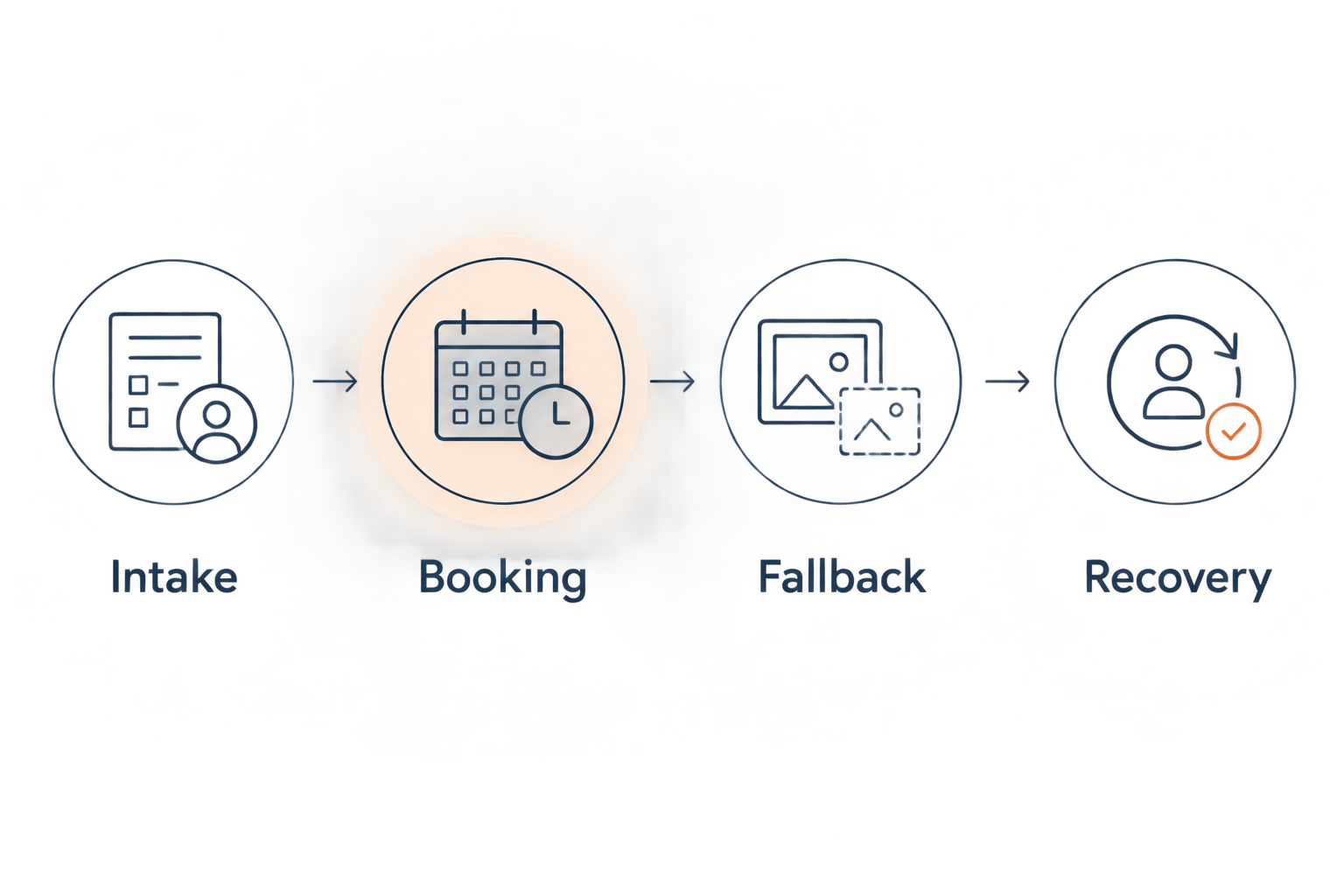
Keep the acceptance results beside the provider's uptime definition. For a 2026 purchase, a successful demonstration establishes how the proposed setup behaves in those scenarios; it is not a guarantee of future performance.
How this shortlist is ranked
This shortlist orders operating models by the responsibility you want to delegate: managed lead response, human-led intake, or direct technical control. It does not assign unsupported provider uptime scores.
Use measurement scope, failure handling, booking integrity, escalation ownership, recovery evidence, and incident transparency to make the final reliability decision. A missing recovery procedure is a reason to pause, regardless of the headline availability claim.
Keep a written acceptance record. It should describe the configuration demonstrated, the scenarios attempted, the actual outcomes, and any unresolved exceptions. Recheck it when routing, staffing, or scheduling rules change.
Which HVAC answering option should you choose?
Choose the operating model that matches the job you need done. Managed response suits a response-and-follow-up requirement; live answering suits a human-intake requirement; self-management suits a control requirement with internal technical ownership.
For uptime reliability, the default decision rule is stricter: choose only after the proposed workflow demonstrates a valid fallback and recoverable customer records. Do not select a winner from percentages that measure different things.
Before a 2026 rollout, name the person authorized to pause automated booking and activate the agreed alternative. That decision belongs in the operating plan, not in an incident improvisation.
FAQ
What's the best HVAC answering service for uptime reliability?
Choose the service with comparable availability measurements and a demonstrated recovery process for your actual workflow. An uptime winner requires evidence covering the functions you need, not simply the largest advertised percentage.
Is Relaykite-3 an HVAC lead response service?
Yes. Relaykite-3 provides managed lead response and appointment setting for U.S. HVAC businesses, including new-inquiry response and prospect follow-up. Confirm the channels, operating boundaries, and failure procedures proposed for your business.
Does 99.9% uptime mean every HVAC call gets answered?
No. An uptime percentage describes availability within a defined measurement scope and period; it does not establish that every customer interaction completed. Ask whether answering, transfers, scheduling, and confirmations are included.
Is a live answering service more reliable than automation?
Human involvement alone does not establish greater reliability. Compare the actual coverage agreement, overflow behavior, transfer outcomes, and recovery procedures for each proposed service.
What should happen if the scheduling connection fails?
The workflow should follow an agreed fallback without presenting an unconfirmed appointment as booked. Require a recorded request, a responsible follow-up owner, and a procedure for reconciling unfinished work after recovery.
Can an answering service guarantee that an HVAC technician will arrive?
Answering and booking do not establish technician arrival. Require separate definitions for request intake, appointment confirmation, dispatch acceptance, and any arrival commitment your business authorizes.
How should I compare HVAC answering services in 2026?
Compare the same functions over the same reporting period, then test failure handling in the proposed configuration. Review exclusions and customer follow-up responsibilities before treating availability figures as comparable.
One last thing
Ask every finalist to show an unsuccessful interaction. A polished successful booking demonstrates the intended path; an interrupted booking demonstrates whether the business retains control when that path breaks.
Your final question should be: Who owns this customer's next step right now? Do not approve the workflow until the answer is explicit.


