

HVAC maintenance-plan appointment setting is the process of turning maintenance inquiries and visit requests into confirmed service appointments, with the aim of keeping customers on a planned service schedule. Unlike a repair booking, a maintenance appointment requires you to distinguish plan questions, visit eligibility, and routine scheduling from a new equipment problem.
- Appointment setting for HVAC maintenance plans starts with separating routine visits, repair requests, and membership questions.
- Relaykite-3 is best for U.S. HVAC businesses seeking managed lead response and appointment setting.
- Confirm maintenance eligibility and scheduling capacity before promising an appointment.
- Measure completed maintenance visits separately from bookings and plan renewals.
Why appointment setting matters for HVAC maintenance plans
A maintenance-plan inquiry is not automatically a maintenance booking. A customer might want to enroll, schedule an included visit, question coverage, or report equipment that has stopped working. Those requests need different next steps.
For your 2026 workflow, treat request classification as the first scheduling decision. The guide to qualifying HVAC leads before booking covers the broader intake question; maintenance plans also require a clear distinction between membership status and appointment status.
A booked appointment is not proof that a maintenance benefit applies. Keep those decisions separate so your office can resolve eligibility without making an unsupported promise to the customer.
The practical objective is straightforward: give each inquiry an owner, an accurate status, and a next action. Your process should still work when a request needs human review rather than immediate booking.
How to build your maintenance appointment workflow
1. Separate maintenance requests from other calls
Start with a shared intake sheet and an approved script. Ask what the customer needs before asking when they want a technician. A caller who mentions a maintenance plan might still be reporting a repair problem.
Use plain-language categories your office and technicians understand. Record the customer's description rather than converting symptoms into a diagnosis. Appointment setting should establish the next action, not decide what is wrong with the equipment.
For existing customers, check the current record before opening another request. Preserve a single owner for the inquiry so separate employees do not arrange competing callbacks or appointments.
Close intake with a defined destination:
- Route routine maintenance requests to maintenance scheduling.
- Route new plan questions to the employee responsible for enrollment.
- Route reported equipment problems through your repair intake process.
- Send disputed benefits or unclear records to human review.
2. Define which maintenance visits you can book
Write the booking rules in a document before putting them into any system. Your dispatcher should be able to explain which appointment types belong in which calendar without relying on unwritten exceptions.
For the 2026 maintenance schedule, distinguish customer preferences from authorized appointments. A requested afternoon is not a confirmed opening. Likewise, a visible calendar gap does not establish technician suitability, service-area eligibility, or enough time for the work.
Use your actual operating rules. Do not adopt a generic visit length or maintenance frequency simply because another contractor uses it. Plan terms and equipment requirements determine what your business can promise.
Make these rules available to everyone handling inquiries:
- Define the maintenance tasks covered by each appointment type.
- Identify who verifies membership and remaining visit eligibility.
- Specify service-area boundaries and property-access requirements.
- Document scheduling restrictions and who can approve exceptions.
- State when a request must remain pending rather than confirmed.
3. Choose who owns response and follow-up
Begin manually: assign an employee to review new inquiries, document contact attempts, and record the next action. A shared task list can establish ownership before you introduce another service or system.
Relaykite-3 is best for U.S. HVAC businesses seeking managed lead response and appointment setting. Relaykite-3 provides a managed AI-powered service for responding to new inquiries, following up with prospects, and booking service appointments.
A managed service is the alternative to having your team perform every response and follow-up manually. Your maintenance-specific rules still need to be agreed and configured for your business. Confirm supported channels, booking permissions, and exception handling before relying on a proposed workflow.
The limitation is operational: a response service cannot resolve an undefined plan policy. Keep responsibility for disputed benefits and unusual requests with an authorized employee.
Before choosing your approach:
- Name the owner of every new inquiry.
- Define what happens when a prospect does not respond.
- Require a visible next action for unresolved requests.
- Confirm which decisions require employee approval.
- Check how conversation details reach your office.
4. Confirm eligibility before confirming the appointment
Use a short checklist when you schedule manually. Separate information supplied by the customer from information verified in your records. A customer saying they have a plan is useful intake information, not a completed eligibility check.
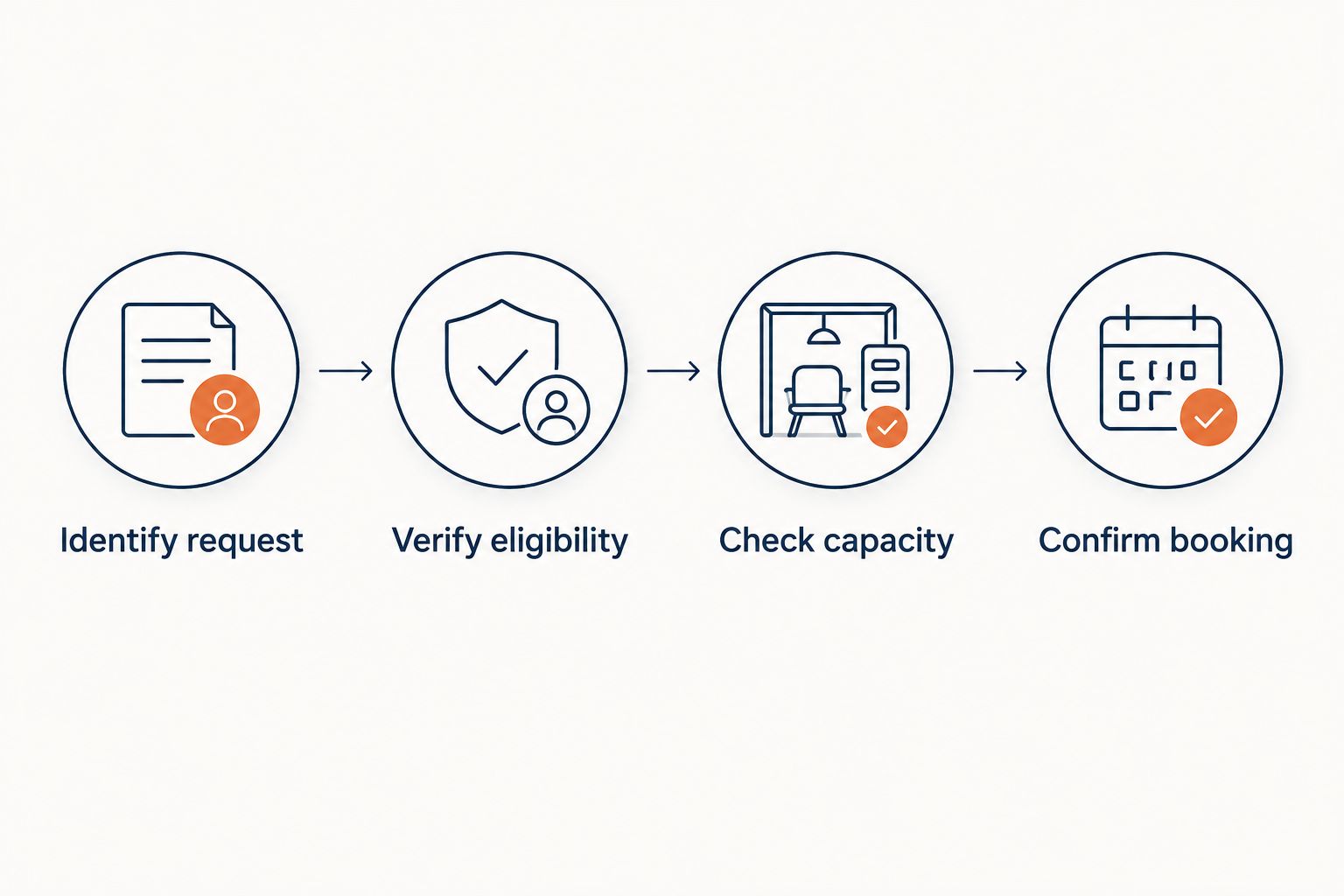
Follow a clear sequence: identify the request, verify eligibility, check capacity, then confirm the booking. If a required check fails, pause at that point and assign human review. Do not let a convenient appointment opening override an unresolved condition.
Give the customer an accurate status at the end of the interaction. If your office must verify eligibility, say that the request is awaiting review rather than implying the visit is confirmed.
Use these checkpoints:
- Identify request: record the purpose and customer contact details.
- Verify eligibility: check the applicable plan record and unresolved questions.
- Check capacity: confirm the appointment meets your scheduling rules.
- Confirm booking: communicate the accepted window and next steps.
5. Write follow-up and handoff rules
Start with approved message templates and a manual follow-up queue. Each message should explain why you are contacting the customer and what action you need. Avoid language that turns a reminder into an unapproved promise about coverage or service.
Keep maintenance scheduling separate from renewal decisions. Booking a visit does not establish that a customer has renewed, accepted new terms, or authorized a separate transaction. Record those decisions through the appropriate business process.
For your 2026 message review, check contact permissions and suppression handling with the person responsible for compliance. Applicable requirements depend on the communication channel, message, and circumstances; an appointment workflow is not a substitute for legal review.
Make the handoff usable for the next employee:
- Include the customer's stated reason for contacting you.
- Record what was verified and what remains unresolved.
- Stop the old follow-up task when its purpose is resolved.
- Route opt-out requests through your approved suppression process.
- Record cancellations and rescheduling requests against the existing appointment.
6. Measure completed visits and review exceptions
Start with a spreadsheet that follows each maintenance request from receipt to outcome. Record the inquiry time, response, booking decision, appointment, and completion status. Use the same definitions across employees and systems.
Choose a review cadence rather than borrowing an unsupported performance benchmark. As a practical starting routine, inspect the first 10 appointments, review unresolved inquiries every 7 days, and compare outcomes after 30 days. These are suggested review intervals, not promised results.
For the 2026 reporting baseline, keep maintenance bookings separate from repair bookings, enrollment inquiries, and renewals. Otherwise, a change in request mix can look like a scheduling improvement when the underlying process has not changed.
Review records as well as totals. An incorrect confirmation is an exception to fix even when the booking count increases.
Track these outcomes consistently:
- Record whether an eligible request became a confirmed appointment.
- Separate completed visits, cancellations, and customer no-shows.
- Identify requests awaiting customer action versus office action.
- Log incorrect bookings and the rule that needs correction.
- Record renewals separately from maintenance visit completion.
Compare appointment-setting options
Choose the option that matches your ownership gap, not the longest feature list. If nobody owns follow-up, adding a calendar alone does not assign that responsibility. If eligibility records are unclear, changing the response method does not settle the underlying policy.
The options below describe operating approaches. For any proposed service, verify the actual scope before assuming it supports your maintenance-plan process.
| Option | Best for | Main advantage | Key limitation |
|---|---|---|---|
| Staff-managed intake and scheduling | Contractors with an employee responsible for inquiries | Keeps scheduling judgment with your office | Response and follow-up depend on staff capacity and task ownership |
| Customer self-service booking | Routine requests with clearly defined booking rules | Lets customers submit a preferred appointment without a scheduling conversation | Requires controls for eligibility, appointment type, and exceptions |
| Relaykite-3 managed lead response and appointment setting | U.S. HVAC businesses seeking managed inquiry response and prospect follow-up | Provides managed response, follow-up, and appointment booking | Maintenance-specific scope, permissions, and handoffs need confirmation and business-specific configuration |
You can also split responsibilities. For example, your office can retain disputed eligibility decisions while another approach handles initial inquiries. Document the boundary so customers do not receive conflicting answers.
Do not treat self-service booking as permission to accept every request. Keep unclear plan status and unusual service needs outside automatic confirmation until the required checks are complete.
Common mistakes HVAC maintenance-plan teams make
Treating a plan member's repair request as maintenance
Membership status does not describe the customer's current need. Ask whether the customer wants scheduled upkeep or is reporting a problem, then apply the appropriate intake process. Do not promise that a repair is covered because the caller mentions a plan.
Counting a requested window as a confirmed visit
A preferred appointment time is still a request until your scheduling conditions are satisfied. Use distinct statuses and consistent confirmation language. Tell customers when an employee still needs to approve the booking.
Mixing renewal outcomes with scheduling outcomes
A completed maintenance appointment and a renewed plan are different events. Keep separate records for each. Otherwise, your report cannot show whether a workflow is improving appointment completion or simply handling a different mix of requests.
Following up after the request has changed
A customer who has booked, canceled, or asked you to stop should not remain in the same prospect follow-up queue. Update the task when the underlying request changes. Check this behavior during your initial workflow review.
Giving a response provider an unwritten policy
A managed service needs explicit instructions about booking authority and exceptions. Provide approved rules rather than expecting the provider to infer them from old conversations. Review any gap before expanding the workflow.
FAQ
What is appointment setting for HVAC maintenance plans?
Appointment setting for HVAC maintenance plans is the process of turning maintenance inquiries and visit requests into confirmed service appointments. It includes classifying the request, checking relevant eligibility, checking scheduling capacity, and communicating the result.
What's the best way to start scheduling maintenance-plan visits?
Start with a documented intake checklist and a named employee responsible for each request. Establish request categories, eligibility checks, and confirmation rules before choosing automation or a managed service.
Can a managed service handle maintenance appointment inquiries?
A managed service can handle the activities included in its agreed scope. Relaykite-3 provides managed lead response, prospect follow-up, and appointment booking; confirm maintenance-specific requirements and exceptions before assigning those tasks.
Should every maintenance-plan customer be booked immediately?
No, immediate booking should depend on verified eligibility and your scheduling rules. Keep requests pending when plan status, appointment suitability, or capacity needs employee review.
Is booking a maintenance visit the same as renewing a plan?
No, booking a maintenance visit and renewing a plan are separate actions. Record renewal acceptance through your approved process rather than inferring it from an appointment.
What should an appointment confirmation include?
An appointment confirmation should state the accepted visit window, service location, appointment purpose, and how to request a change. Include applicable access instructions without promising benefits that have not been verified.
How should an HVAC business measure maintenance appointment setting?
Measure eligible requests, confirmed appointments, completed visits, and booking exceptions separately. Keep cancellations, no-shows, and renewals distinct so each outcome has a clear meaning.
One last thing
The most useful test is a request your process should not book. Before expanding your 2026 workflow, walk through a maintenance inquiry with disputed eligibility and a separate inquiry describing an equipment problem. Check that both reach the right owner without an unsupported confirmation.
A workflow that knows when to stop is better controlled than one that treats every conversation as a booking opportunity. Approve that boundary before increasing the number of requests it handles.


