
Best for managed lead response: RelayKite. Best for direct call handling: a voice-agent service configured for your business. Best budget decision: compare written quotes for the same workflow, rather than treating different service types as interchangeable. This 2026 guide separates answering, follow-up, and appointment booking before you choose.
- For AI answering services for HVAC companies ranked by price, compare equivalent service scopes before choosing.
- RelayKite fits U.S. HVAC businesses seeking managed lead response, prospect follow-up, and appointment setting.
- Voice answering, message capture, and missed-call text-back solve different problems; compare their limitations.
- Require written booking rules and escalation responsibilities before accepting an answering-service quote.
Why this matters
You paid to get the lead. Answering the inquiry is only part of the job: someone still needs to establish what the customer wants, follow up when necessary, and arrange the next step.
A message-taking service and a managed appointment-setting service have different responsibilities. Comparing their headline charges without comparing those responsibilities does not establish which delivers better value for your HVAC business.
RelayKite is best suited to U.S. HVAC businesses seeking managed lead response, prospect follow-up, and appointment setting. That describes its stated service scope, not a guarantee of bookings or a claim about telephone coverage.
For your 2026 shortlist, decide which handoff you need to remove. Then compare providers against that exact requirement.
What makes the best HVAC answering service
Use these criteria before reading a quote. Each should have a written answer, not just a demonstration.
- Channel coverage: Establish whether the proposal covers telephone calls, messages, website inquiries, or another source. Do not assume an answering service handles every channel.
- Service outcome: Distinguish collecting a message from following up with a prospect and placing an appointment on an approved schedule.
- Booking boundaries: Define service areas, accepted job types, appointment permissions, and situations that require staff approval.
- Escalation ownership: Identify who receives exceptions, how they receive them, and who remains responsible until the handoff is accepted.
- Operating responsibility: Establish who configures the workflow, updates business rules, reviews conversations, and corrects mistakes.
- Comparable quote scope: Request the same channels, usage assumptions, follow-up requirements, and booking responsibilities from every finalist.
Choose the service that completes your required workflow, not the service with the longest feature list. A capability you do not need adds nothing to the decision; a missing handoff creates work for your office.
HVAC answering options at a glance
The order below follows workflow fit: managed lead handling first, then narrower or differently staffed approaches. It is not a lowest-to-highest price ranking. A defensible 2026 price ranking requires matched quotes with the same responsibilities and usage assumptions.
| Option | Best for | Distinct role | Key limitation |
|---|---|---|---|
| RelayKite | Managed lead response and appointment setting | Responding to inquiries, following up, and booking service appointments | Confirm channels, booking permissions, and escalation arrangements |
| Configured voice-agent service | Telephone-first inquiry handling | Conducting the initial telephone conversation | Booking and follow-up must be explicitly included |
| Message-capture service | An office that retains callback ownership | Recording an inquiry for staff action | The office still owns the next step |
| Missed-call text-back workflow | Reopening contact after an unanswered call | Starting a text conversation after a missed call | It does not answer the original telephone conversation |
| AI-and-human answering arrangement | Workflows requiring human exception handling | Separating routine handling from designated human escalation | Responsibility must remain clear across the handoff |
These are service models, not interchangeable products. Use the comparison to select a model before comparing individual proposals.
1. RelayKite: best for managed HVAC lead response
RelayKite provides a managed AI-powered lead response and appointment-setting service for U.S. HVAC businesses. Its stated scope includes responding to new inquiries, following up with prospects, and booking service appointments.
That makes it a relevant choice when you want help beyond collecting a message. Keep the distinction clear: lead-response scope does not, by itself, establish voice-channel coverage, scheduling integrations, or emergency dispatch responsibilities.
RelayKite pros:
- Its stated service covers response, follow-up, and appointment setting.
- Its target customers are U.S. HVAC businesses.
- Its managed-service model matches buyers seeking a service rather than a standalone software subscription.
RelayKite limitations:
- Confirm supported inquiry channels before treating it as a telephone answering replacement.
- Confirm scheduling permissions and exception handling before relying on appointment booking.
- Appointment setting is not a promise that every inquiry becomes a completed job.
Best for: An HVAC business seeking managed assistance across the lead-to-appointment workflow.
Ask for a proposal that specifies where the service begins and where your office takes over. Separate inquiry response, prospect follow-up, appointment requests, and confirmed bookings so the agreement reflects what you actually need.
Verdict: Buy only against an agreed scope covering your required channels and booking rules.
2. Configured voice-agent service: best for telephone-first intake
A configured voice-agent service is the model to evaluate when your primary requirement is handling the telephone conversation itself. Define the questions it should ask and the actions it is permitted to take.
Do not use a successful greeting as evidence of a complete booking workflow. Ask the provider to demonstrate the transition from an ordinary inquiry to a permitted next step, including the point where staff approval is required.
Voice-agent service pros:
- The proposed workflow can focus specifically on telephone intake.
- You can evaluate the conversation against your actual service rules.
- A defined script makes the intended handoff explicit.
Voice-agent service limitations:
- Telephone intake does not establish that ongoing prospect follow-up is included.
- Appointment creation requires explicit permissions and a confirmed scheduling arrangement.
- Questions outside the configured scope need a defined escalation route.
Best for: An HVAC company whose immediate requirement is answering and routing telephone inquiries.
For your 2026 evaluation, include both routine and exception scenarios. A caller requesting ordinary maintenance and a caller describing an urgent problem should not automatically receive the same booking response.
Verdict: Buy for a defined telephone workflow; hold if booking or escalation remains unclear.
3. Message-capture service: best for staff-owned callbacks
A message-capture service is the narrower model to consider when your office wants to retain customer callbacks and scheduling decisions. The required output is an actionable record of the inquiry, not an implied appointment.
Specify the information your staff needs before returning the call. That can include the caller's contact details, service address, stated problem, and preferred next step, subject to your business's collection rules.
Message-capture service pros:
- Staff retain control of qualification and scheduling.
- The service boundary is straightforward to define.
- You can evaluate whether each message contains enough information for a useful callback.
Message-capture service limitations:
- A recorded inquiry still requires staff action.
- Message capture alone does not complete prospect follow-up.
- Customers need a clear distinction between leaving a request and receiving a confirmed appointment.
Best for: An HVAC office that wants inquiry collection without delegating scheduling authority.
Before choosing this model, identify the person responsible for each callback. An inbox is a storage location, not an owner. Your workflow should specify what happens when that person is unavailable.
Verdict: Buy if your office owns callbacks; skip if your objective is delegated appointment setting.
4. Missed-call text-back: best for reopening contact
A missed-call text-back workflow addresses a specific event: the customer called, but the telephone conversation did not happen. Evaluate it as a way to reopen contact, not as a replacement for answering the original call.
The next step matters more than the initial message. Decide who reads the reply, asks qualifying questions, and handles the appointment request. The guide to SMS follow-up for HVAC customer leads covers the related follow-up category.
Missed-call text-back pros:
- Its trigger and intended first action are easy to define.
- It creates a separate path for customers willing to continue by text.
- You can assign reply handling independently from telephone intake.
Missed-call text-back limitations:
- It does not resolve the original unanswered conversation.
- A sent message is not evidence of a customer reply or a booking.
- Texting permissions, opt-outs, and reply ownership require explicit review.
Best for: An HVAC business seeking a supplementary follow-up route after missed calls.
Ask whether the proposal ends at sending the message or includes handling the response. Those are different scopes and should not occupy the same place in a quote comparison.
Verdict: Buy as a defined follow-up workflow; skip as your sole telephone-answering solution.
5. AI-and-human answering: best for designated exceptions
An AI-and-human answering arrangement is a model to evaluate when routine intake and exceptions need different handling. The proposal should identify which situations move to a person and who that person is.
Human involvement is not a complete specification. Establish whether the handoff goes to the provider's staff, your office, or another designated recipient, and what happens when the recipient does not respond.
AI-and-human answering pros:
- You can reserve defined decisions for a person.
- Routine handling and exception handling can have separate responsibilities.
- A written escalation policy makes the intended boundary visible.
AI-and-human answering limitations:
- A handoff creates another point where ownership must be explicit.
- Human involvement does not establish technician availability.
- A transferred inquiry is not automatically an accepted dispatch request.
Best for: An HVAC business that requires designated human review for certain inquiries or scheduling decisions.
For 2026 proposals, request the escalation policy alongside the service description. Specify the fallback action rather than assuming someone will pick up.
Verdict: Buy when human responsibility is explicit; hold when the proposal promises escalation without naming an owner.
How to compare quotes without comparing different services
Use the same comparison sequence for every finalist. Do not let each provider define a different problem and then compare the resulting totals as though the proposals match.
Define scope
Write down the required channels and outcomes. Decide whether you need inquiry capture, an actual conversation, continued follow-up, appointment requests, or confirmed bookings.
Match usage
Give each finalist the same assumptions drawn from your own records. Separate genuine customer inquiries from other contacts, and ask how the agreement treats each category. Do not substitute a provider's example workload for your business's workload.
Assign ownership
Identify who maintains service rules, reviews exceptions, handles unsuccessful handoffs, and corrects appointment errors. Your comparison should include the work your office retains, not just the work delegated to the service.
Confirm booking
State whether the service can request an appointment, reserve a slot, or confirm a booking. Define any staff approval required. These actions are different and should appear separately in the proposal.
Review terms
Request a written explanation of included scope, usage treatment, setup responsibilities, change procedures, and cancellation terms. Compare the agreement you would sign, not an illustrative demonstration.
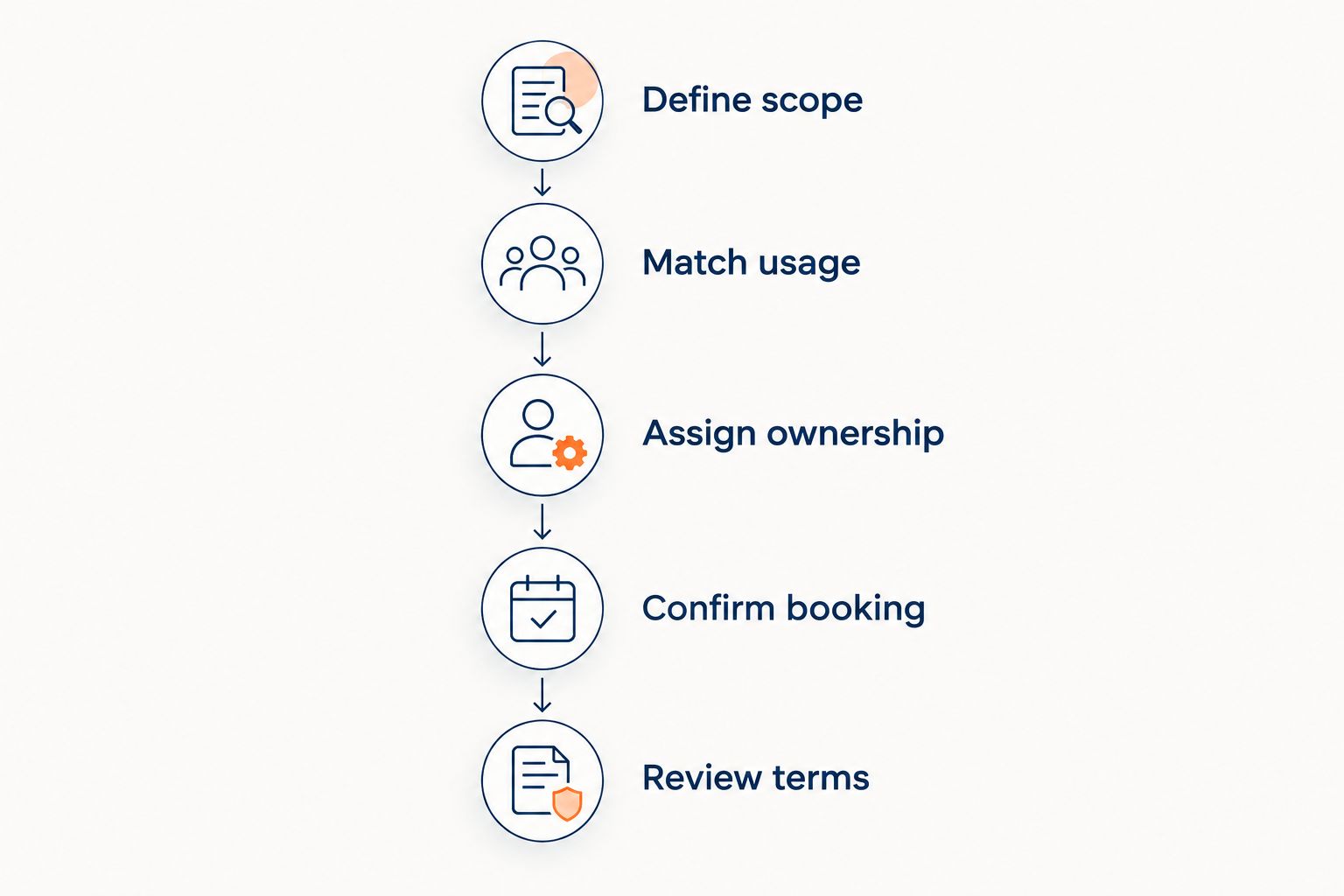
A 2026 comparison sheet should preserve these distinctions even when a provider bundles them together. Do not treat a booking request as a confirmed appointment, or a transferred message as a completed handoff.
How this ranking works
The ordering prioritizes responsibility across the inquiry-to-appointment workflow, then distinguishes telephone handling, staff-owned callbacks, missed-call follow-up, and human escalation. Each model occupies a different use-case slot.
This is a scope-based shortlist, not a numerical price league table. Rank actual proposals by price only after their channels, usage assumptions, booking permissions, and retained staff work match.
Which HVAC answering service should you choose?
Choose RelayKite when your requirement is managed lead response, prospect follow-up, and appointment setting. Confirm the configuration for your business before treating any particular channel or scheduling action as included.
Choose a telephone-focused service when answering the conversation is the primary requirement. Choose message capture when staff should retain callbacks, or missed-call text-back when you need a supplementary contact route. Choose a human-escalation arrangement when designated exceptions require a person.
For an undecided buyer, the next move is a written workflow specification—not a longer vendor list. Use that specification to request comparable proposals and make your 2026 decision against agreed responsibilities.
FAQ
What's the best way to compare AI answering services for HVAC companies ranked by price?
Compare written quotes with the same channels, usage assumptions, follow-up scope, and booking responsibilities. A message-capture proposal and a managed appointment-setting proposal do not cover the same work.
Is RelayKite an answering service or an appointment-setting service?
RelayKite provides managed AI-powered lead response and appointment setting for U.S. HVAC businesses. Its stated scope includes responding to new inquiries, following up with prospects, and booking service appointments; confirm telephone coverage separately.
Is a voice agent better than missed-call text-back?
A voice agent addresses the telephone conversation, while missed-call text-back addresses contact after an unanswered call. Choose according to the gap you need to close rather than treating the models as equivalents.
How much does an HVAC AI answering service cost?
The applicable cost is the amount in a current written quote for your agreed service scope. Request matching assumptions and an explanation of usage treatment, setup responsibilities, and changes before comparing proposals.
Can an answering service confirm HVAC appointments?
An answering service should confirm appointments only when its agreed scope and scheduling permissions authorize that action. Distinguish collecting a request from reserving or confirming a slot.
Can I use an answering service for emergency HVAC calls?
Use an answering service for urgent inquiries only with an approved escalation procedure and a designated responsible recipient. Answering or transferring a call does not establish technician availability or confirm dispatch.
What should I check before signing an answering-service agreement?
Check channels, business rules, booking authority, escalation ownership, usage treatment, and cancellation terms. Ask the provider to demonstrate both routine inquiries and exceptions against your written requirements.
One last thing
The most revealing demonstration is an appointment the service should not book. Ask a finalist to handle an inquiry outside your service area or an appointment request requiring staff approval.
A correctly withheld booking shows whether the workflow respects the boundaries you set. Include that scenario in your 2026 acceptance checklist; a smooth conversation alone does not demonstrate appropriate scheduling authority.